State of Corporate Purpose 2026
Key insights
Purpose survived the pressure test.
Despite a year of political scrutiny, funding shifts and public narrative about corporate retreat, 78% of companies continued their purpose work as before.
The era of quiet purpose may be ending.
Companies are focusing on brand reputation and trust, with communications and storytelling earning the largest budget jump in this year.
Corporate impact leaders are shifting from defense to strategy.
From AI adoption to volunteering for skills development to enterprise-wide collaboration, a new infrastructure for a more resilient, business-aligned approach to purpose is emerging.
A year spent fighting for purpose
Last year put corporate purpose to the test. With unrelenting scrutiny coming from all directions, companies held firm on their purpose commitments, even as they recalibrated how those commitments showed up publicly. And that persistence paid off. Corporate giving rose almost 8 points year-over-year, the vast majority of companies stayed the course on their purpose strategies, employee volunteerism soared to new heights and impact leaders are feeling proud of the decisions their companies made. It was a year where impact was fought for, and well earned.
The road ahead
As we press on into the second half of this decade, we continue to face uncertainty on almost every front: economic volatility, job market instability, AI-induced anxiety and opportunity, funding squeezes, new charitable tax reforms and policies, fraught elections, escalating conflicts and war, and a continued trust crisis.
But with all of the hard-won lessons of the first half of the decade, corporate purpose is ready for its next chapter. One where we shift from a defensive posture to a strategic recalibration. Where we pause, reflect and consider what is needed for the future. Where we continue to align impact with the core of business purpose. Where we work together with a collective mindset to make purpose more resilient and measurable.
2026 is the year for a new playbook for purpose-driven business.
Top 5 trends in corporate purpose in 2026
- 01
Purpose gets political
Corporate scrutiny is intensifying from all directions. Impact leaders are responding by building new cross-functional alliances and learning to navigate a charged sociopolitical environment hand-in-hand with legal, compliance and corporate communications. - 02
A quiet revolution in corporate purpose
Despite mainstream narratives about corporate backpedaling from purpose, the data tells a different story. CEOs remain committed, companies continue the work and impact professionals feel proud of how their organizations show up. - 03
Trust is the new north star
Companies are investing heavily in communications and storytelling to build brand reputation. But trustworthy narratives require real impact data and stories gathered in partnership with nonprofits, in ways that are scalable for companies and sustainable for the organizations delivering the impact. - 04
The AI paradox: high hopes and hesitancy
AI is transforming purpose programs, but companies are drawing a clear ethical line between AI as a tool for efficiency and AI as a decision-maker. - 05
Volunteering is ready for its next act
As companies prepare their workforces for an AI-driven future, volunteering is emerging as the training ground for the human skills that automation can't replicate.
Purpose gets political

74% of companies said the political and regulatory environment influenced their strategy
External scrutiny over purpose programs led to internal pressure. As a result, corporate impact professionals increased their cross-functional collaboration to meet the expectations of their growing set of stakeholders.

What’s being scrutinized – and why it matters
It's not just that there are more critical eyes on corporate purpose, it’s where those eyes are focused. Companies reported that the following areas saw the sharpest increases in scrutiny:
Reported areas of increased scrutiny

What was once a question of "where should we focus our giving?" has become "how do we invest responsibly while managing risk?" Impact decisions now carry even more legal, reputational, financial and political weight with every dollar deployed.
Nonprofits are absorbing the impact
Increased scrutiny is slowing down investment in critical cause categories
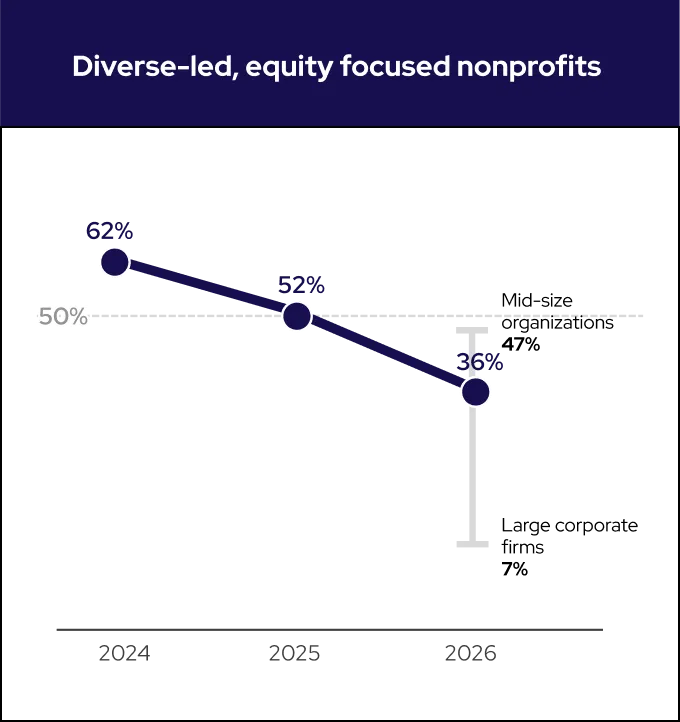
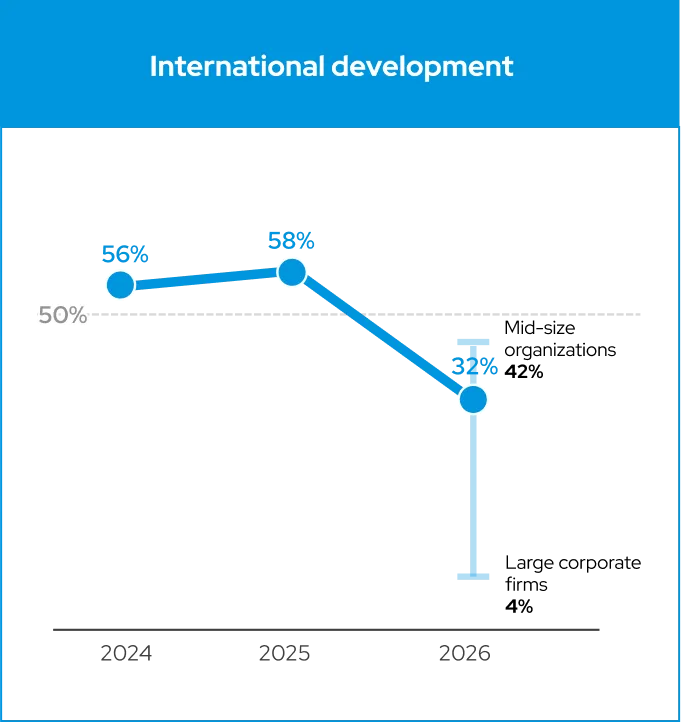
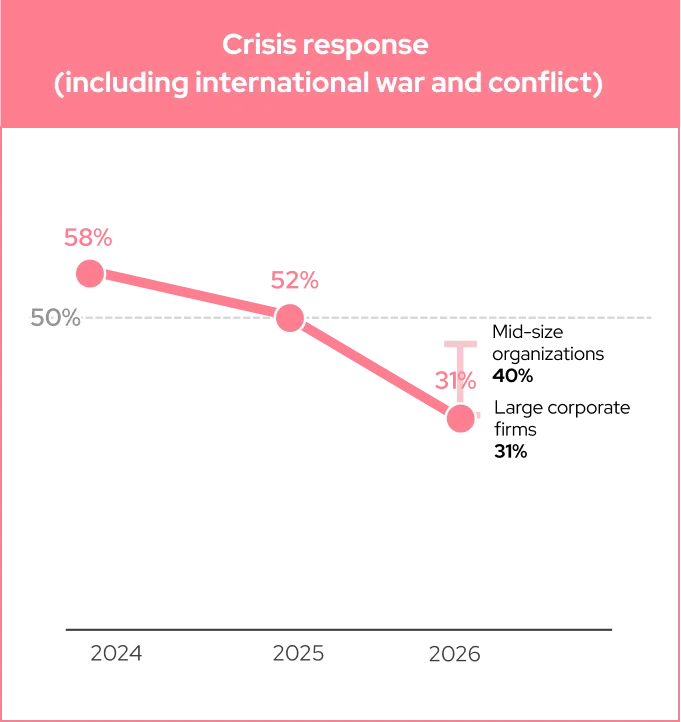
Year-over-year grantmaking trends tell a clear story: companies are pulling back on cause categories that have become politically charged.
The percentage of companies anticipating increased investment in:
Protecting purpose took cross-functional discipline
Defending corporate purpose in this environment was not a one-team job. As predicted in 2025, impact leaders forged new partnerships across legal, risk, communications, HR and more, turning what had been occasional collaborations into standing working relationships. That cross-functional muscle will be tested again soon: mid-term elections in the U.S. are sure to reignite political discourse on corporate purpose in the media and in the workplace.

Acting on purpose
The politicization of corporate purpose is the new operating environment. Companies that build the infrastructure to navigate it will be poised to protect their business in the long-term.
Here's where to focus:

Make cross-functional collaboration permanent. The partnerships between impact, legal, risk, communications and HR teams that formed under pressure shouldn't dissolve when the pressure eases. Formalize them. Give them clear roles, a regular cadence and a shared decision-making framework that doesn't require a crisis to activate.
Build a political readiness plan before you need one. With U.S. mid-terms on the horizon, scenario-plan now for political developments that could affect your purpose work. Define your decision-making criteria, your communications approach and your internal escalation process before the moment demands it.
Take stock of how strategy shifts have affected your nonprofit partners. If you must change your eligibility criteria, funding focus areas or compliance requirements, be as surgical as possible. And ask what these changes mean for the organizations on the other end. Where possible, provide transition support — advance notice, bridge funding, exposure to your employees or even introductions to other funders who might be well suited to step in — to ease the disruption.
Learn to separate political noise from regulatory reality. Not every headline warrants a strategy change. Create a clear line that distinguishes between regulatory requirements that demand action and political rhetoric that does not. This will help your company stay grounded when the next wave of scrutiny hits.
Connect your purpose strategy to your business strategy. Companies that can clearly rationalize their funding and eligibility decisions within their broader business focus and goals are better positioned to withstand scrutiny. The rationale for your giving should be clear enough that an employee, a board member or a regulator can understand it without a long briefing document.
A quiet revolution in corporate purpose

94% of CEOs are supportive of the company's corporate purpose programs — internally


The work continues, even when the messaging doesn't
The gap between public narrative and operational reality is wide. While public perception often frames corporate purpose as being in decline, the data paints a more hopeful picture.
Over the last year, companies operated with both courage and caution in equal measure. Corporate impact professionals reported strong belief in their companies' willingness to act, while acknowledging they were cautious about being vocal in certain areas. But it’s clear that mid-sized organizations used their unique positions and missions to stand firmly where large corporations couldn’t or wouldn’t.
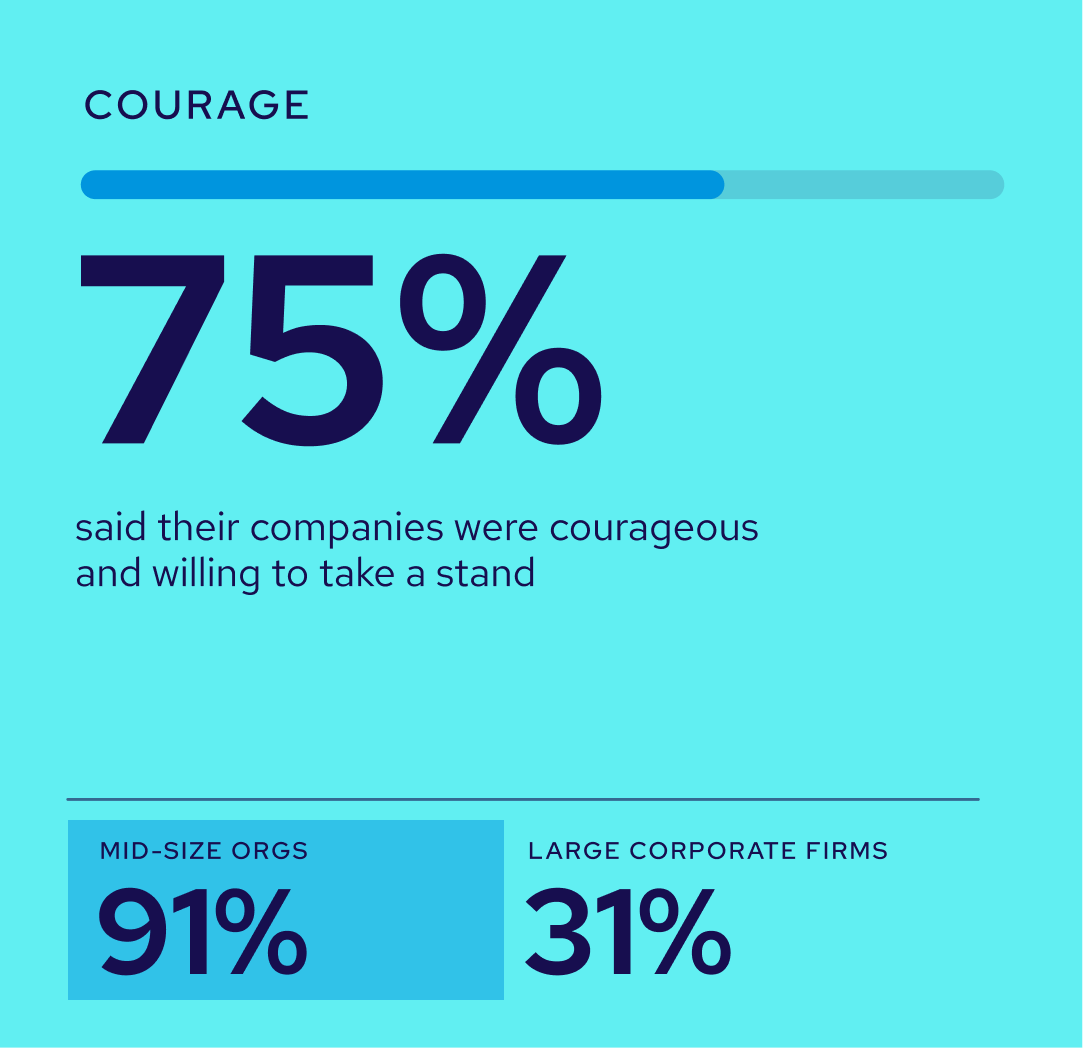
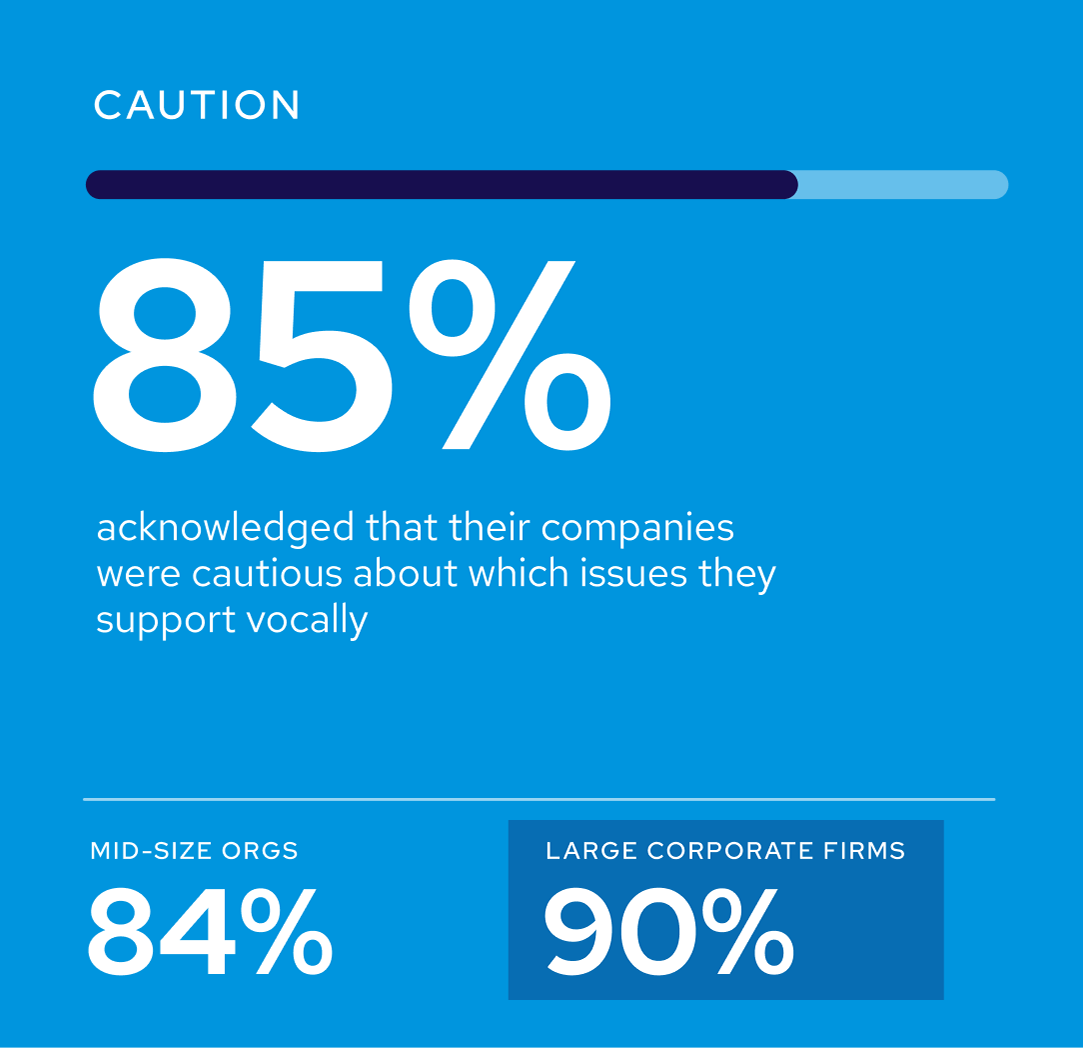
These two numbers aren't contradictory. They describe a profession that has learned to be both brave and surgical — doing the work without always making it a headline. But the continued work is not without cost. As we saw in Trend 1, shifts in which nonprofits and programs companies support — and how nonprofits remain eligible — mean that staying the course on purpose doesn't mean everything stayed the same for the organizations on the receiving end.
78% of companies continued all of their purpose work in the same way as previous years, even in the face of public risk. That number drops to 57% among large corporate firms — still a majority, but a reminder that size and visibility come with added pressure.
Companies can continue their work in the same way — delivering grants based on the same cause pillars, or using the same community investment strategies — while simultaneously changing who they fund and how those organizations achieve eligibility. It may seem like a small change. After all, they’re still delivering on their purpose. But it can be a major disruption for the organizations they work with.
Corporate impact leaders are proud of how their companies showed up
In what was a difficult year, impact professionals — the people closest to the work and therefore in a position to see it with the most critical eye — shared overwhelmingly positive sentiment about their companies' commitment to purpose.
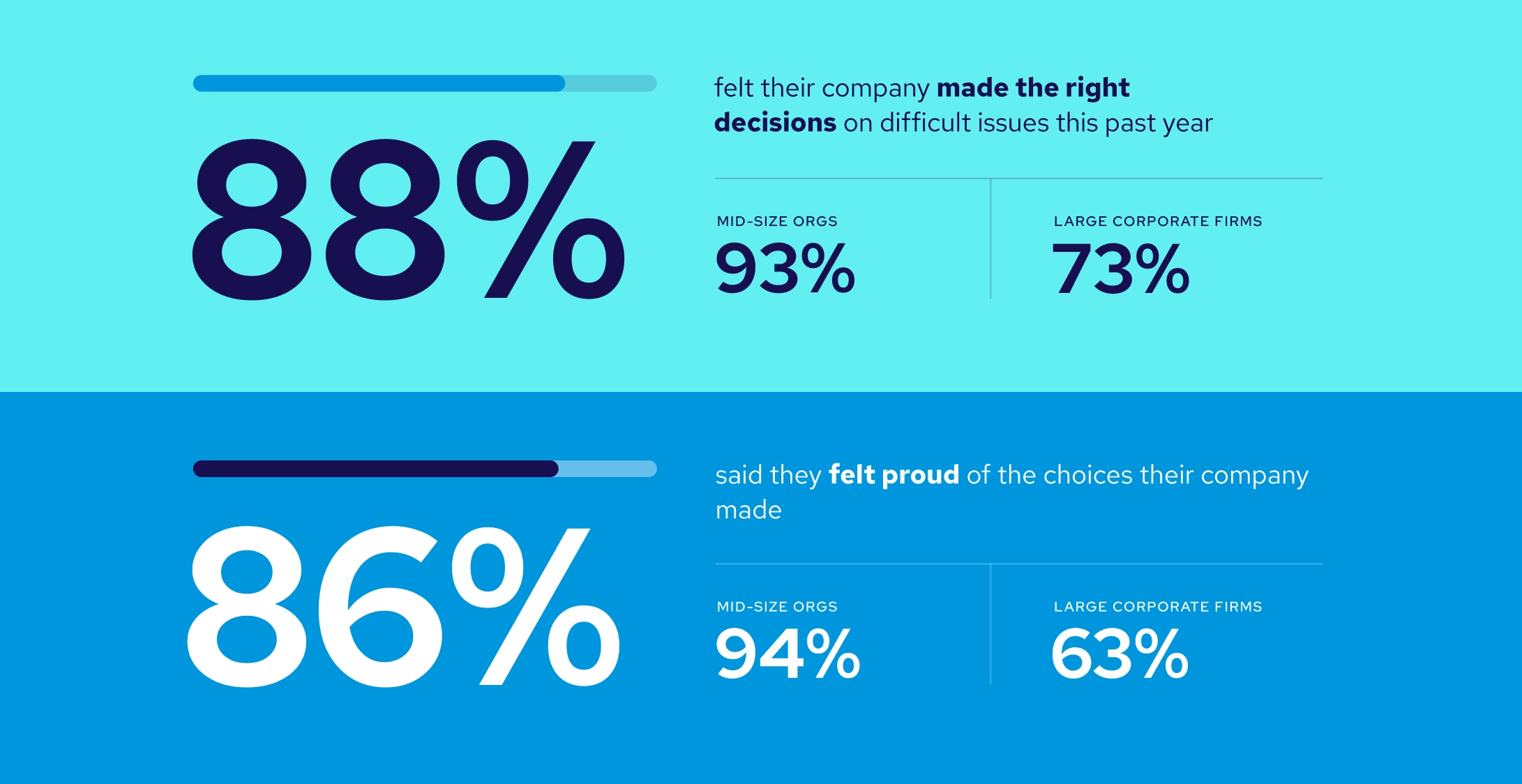
After years of data showing burnout and retention risk among impact professionals, this is a meaningful shift. It suggests that the hard work of the past year has left impact leaders feeling more in tune with their companies' direction.
Acting on purpose
The quiet revolution in corporate purpose is real, but it's fragile. Companies that mistake quiet commitment for permission to deprioritize purpose risk losing trust.
Here's where to focus:
Protect the work, even when the messaging changes. Being less vocal is a valid choice, but being less intentional internally is not. If your company has shifted its public communications strategy around purpose, the internal commitment should still be communicated clearly and with proof. Make sure your leadership team, your employees and your most critical nonprofit partners all understand the "why" behind any shifts in how you show up — publicly or privately.
Use impact professionals as a barometer. In moments of crisis and opportunity, CEOs and other executives must ensure CSR leaders have a seat at the table. As the liaison between the company and the community, nobody is better suited to create informed strategies and communicate across multiple stakeholder groups.
Measure the impact of strategy changes on nonprofit partners. 78% of companies say the work continues, but 65% changed which nonprofits they fund. The commitment may be just as strong, but if it's flowing toward less contentious causes, the organizations working in more challenging spaces may be getting left behind. Take time to assess the degree of change your programs have undergone, and solicit direct input from current and former partners on how those shifts have affected them and if and how you can help in other ways.
Trust is the new north star

91% of companies say corporate reputation and trust is the #1 motivator for investment in corporate purpose
The silent period for corporate purpose may be coming to a fast end. This year's data reveals that all bets are on communications and storytelling in service of building corporate reputation and trust.
With this renewed emphasis comes heightened demand for impact data, reporting and stories from nonprofits. Corporate impact leaders have an opportunity — if not an obligation — to revisit their data collection and reporting approaches to ensure they are doing it in ways that are scalable and sustainable.
ATB Financial is turning the reporting burden on its head. Instead of investing its budget in internal corporate reporting tools, the Canadian bank pays the costs for its nonprofit partners to register and verify their impact data in the Impact Genome Registry. Once a nonprofit's data is verified, they can use that standardized data to secure funding from any funder, including ATB's competitors. The approach also eliminates the need for nonprofits to recreate impact reports or answer custom metric questions for every organization they work with. By directing its investment toward the nonprofits rather than toward its own administrative systems, ATB Financial is building capacity and resilience across the broader funding ecosystem, not just within its own programs.

What's motivating companies to invest in purpose
The factors driving investment show that the business case for purpose has never been clearer.

All six motivators are bunched together tightly in terms of priority rankings, but four of the six are notably directly tied to brand perception. Social impact ranks fifth. That says something about where companies are focusing their purpose efforts right now.
Communications and storytelling have sprung up the priority list
In a ranking of areas where companies are increasing budget, communications and storytelling ranked 9th in 2024, jumped into the top four in 2025 and landed at #2 for 2026. Companies are clearly increasing their focus on storytelling as a central component of their purpose strategy. And as long as those narratives are backed by real investment in impact, this shift can have a powerful positive effect on a company's brand.
But how mid-size organizations and large corporate firms are allocating their budgets looks quite different.
Reported areas of increased budget
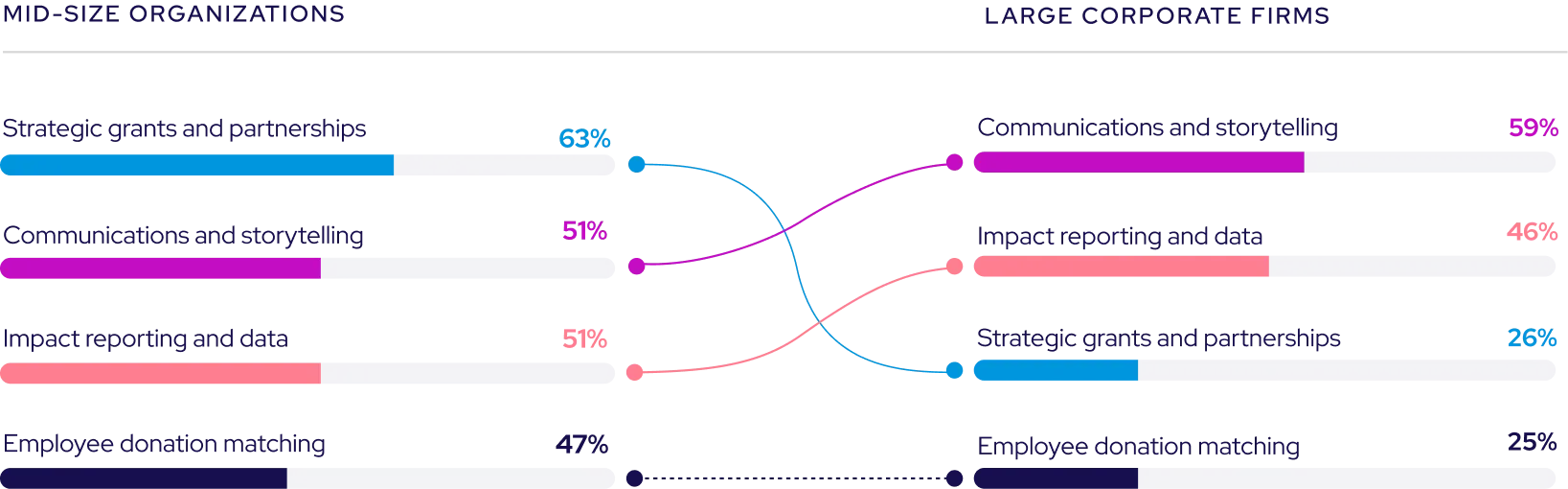
The imbalance in large corporate firms is worth noting. It may be that large corporate firms are simply re-visiting their budgets to place more focus on communications and storytelling, and not actually increasing their investment relative to their social investments.
The reporting burden on nonprofits isn't getting lighter
Only 10% of companies expect less reporting from nonprofits. This is a reality check compared to last year, when 70% of companies said they were actively considering changing their measurement methods to decrease the burden on nonprofits.
And that burden is growing. 42% of nonprofits report an increase in demands for custom impact metrics, and 44% are seeing a higher volume of custom storytelling requests. The cost of meeting those demands falls disproportionately on the organizations least equipped to absorb it: 48% of nonprofits handle the extra workload through unpaid staff overtime, and almost half (49%) report that donors rarely or never fund the associated effort.
As impact leaders work to maintain trust in their programs both internally and externally, they need proof from nonprofits that their investments are working. But the demand for that proof comes at a material cost to the organizations delivering the impact. There is work to be done in finding the balance between robust reporting and maintaining nonprofit capacity, and it points to the benefit of streamlined, standardized reporting that nonprofits can anticipate and deliver without straining their already limited resources. And the opportunity goes further. When corporations center and amplify the nonprofit’s work, they help those organizations find new funders or new sources of support, helping them to become more self-sustaining in the long run.

“In this next wave of purposeful communications, I advise companies to move away from self-centered stories of their own impact — and instead shine a light on the changemakers and innovators who they are funding or partnering with to create a positive impact.”

Good is the New Cool
Acting on purpose
The surge in communications and storytelling investment is a positive signal. It means companies are ready to talk about their purpose work again. But the credibility of those stories depends entirely on what's behind them.
Here's where to focus:
Keep an eye on your investment mix. As you scale up communications and storytelling, consider allocating budget and resources to support nonprofits with data collection, analysis or storytelling. Where can you bring skills or financial support as part of your funding to help nonprofits generate the data and stories you need in a more sustainable way? And how can you use your communications strategy to elevate their work in a way that potentially allows them to find more funders?
Activate an integrated narrative. To drive true impact, companies must move from passive broadcasting to an integrated strategy that aligns impact, marketing and communications teams. The recent surge in storytelling investment is only effective if it is grounded in ethical, high-fidelity proof rather than surface-level PR. Externally, this elevates the nonprofit's visibility to new funders and builds brand authority. Internally, it transforms corporate purpose into a source of genuine employee pride and advocacy. When the internal culture believes the story because they see the rigor behind it, the external marketing gains an authentic power that cannot be manufactured.
Revisit your reporting requirements for nonprofits. In an environment where only 10% of companies are reducing reporting requirements, consider where you can alleviate nonprofit burden. For programs with a large set of grantees, consider adopting measures that nonprofits already track or collecting standardized outcomes data through third-party platforms like Impact Genome or True Impact so you and your nonprofits can focus on the investments that require more custom reporting.
Reassess and focus your measurement strategy. As your purpose strategy shifts, make sure your metrics shift with it. Rather than measuring everything you can, identify the minimum viable metrics that matter most. What do you need for internal learning and investment optimization? What do your board and executives need to see? What fuels your storytelling? Build a simple matrix that maps each metric to its audience and purpose. If a data point doesn't serve one of those three functions, ask yourself if you can stop collecting it.
Align your measurement to local context. The most meaningful measurement reflects what communities actually need. As an example, Enbridge aligns each grant to localized strategies shaped by community input across safety, education, sustainability and Indigenous reconciliation. Rather than applying a single measurement framework across all grants, Enbridge assesses impact in ways that reflect local context and community-defined success, tracking results through partner-reported outcomes and program-level analysis. This is an approach that works well with more strategic partners and when funded by corporations to ensure that the burden of proof is not on nonprofits alone.
The AI paradox: high hopes and hesitancy

87% of companies say AI will reduce burden for nonprofits
Expectation vs. investment in AI adoption
The more mature a company's AI adoption, the more convinced they are of its potential, and the more strongly they believe that AI should be used to increase nonprofit capacity. But even those that aren’t investing in AI for social impact have high hopes for what it can do for nonprofits.
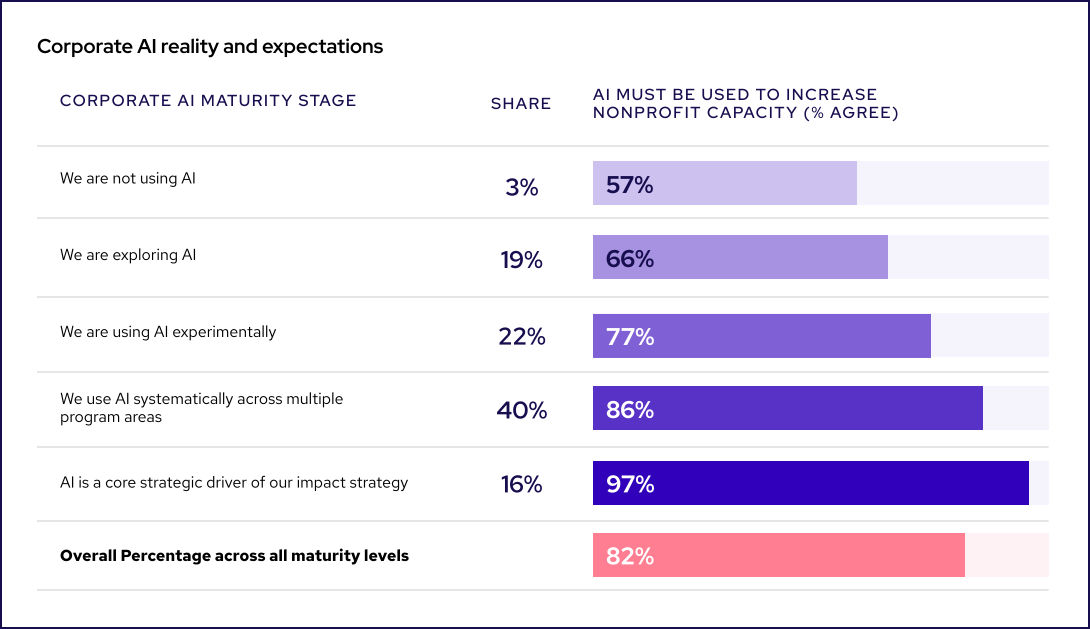
The largest group, at 40%, is using AI systematically across multiple program areas. Combined with the 16% who say it's a core strategic driver, more than half of companies are fully invested. But the gap between stated belief in AI's potential and actual strategic investment suggests that we are still in a transitional phase.
The optimism and concern of AI adoption
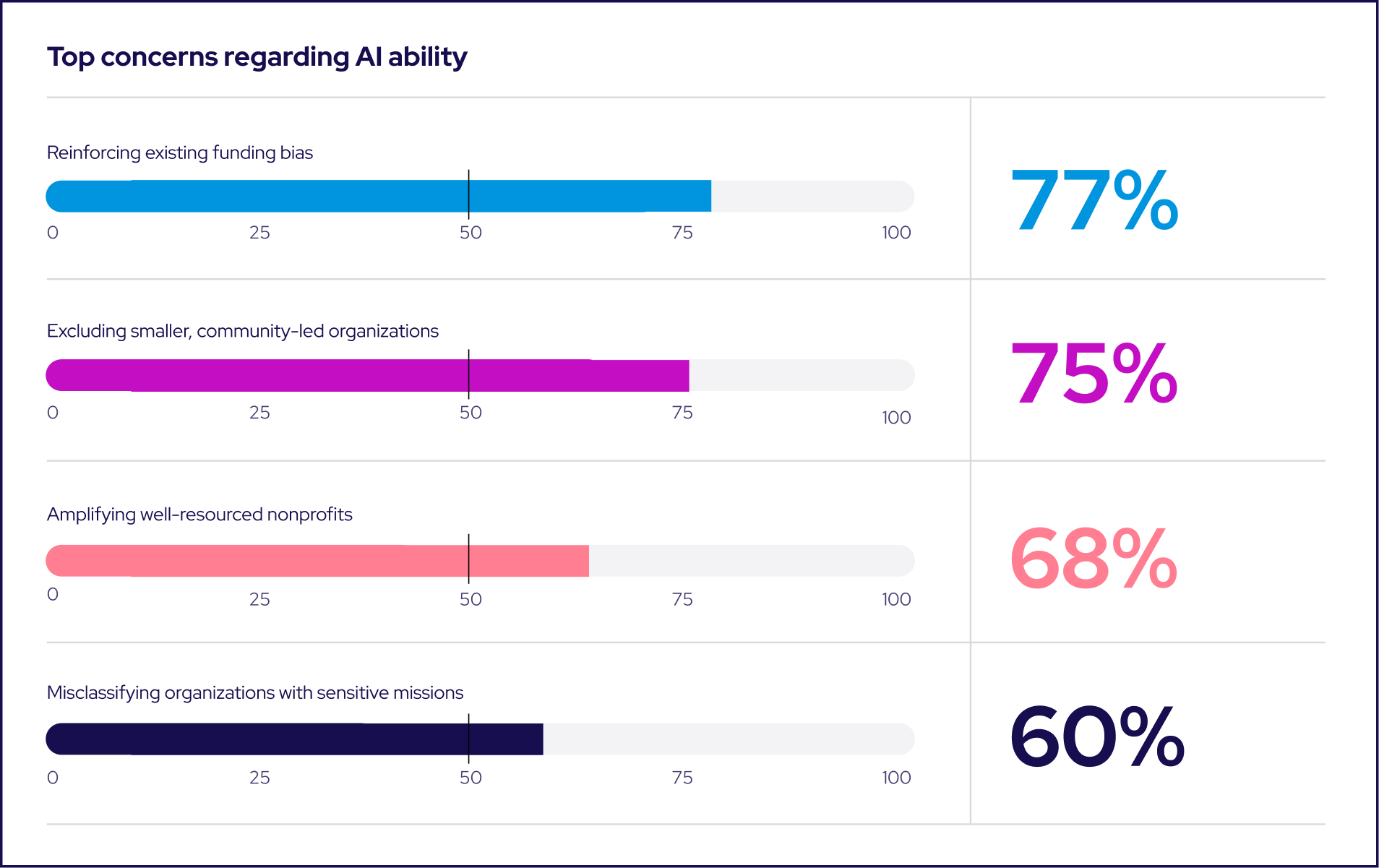
Enthusiasm around AI’s potential is tempered by real anxiety about what it gets wrong, especially when applied to funding decisions.
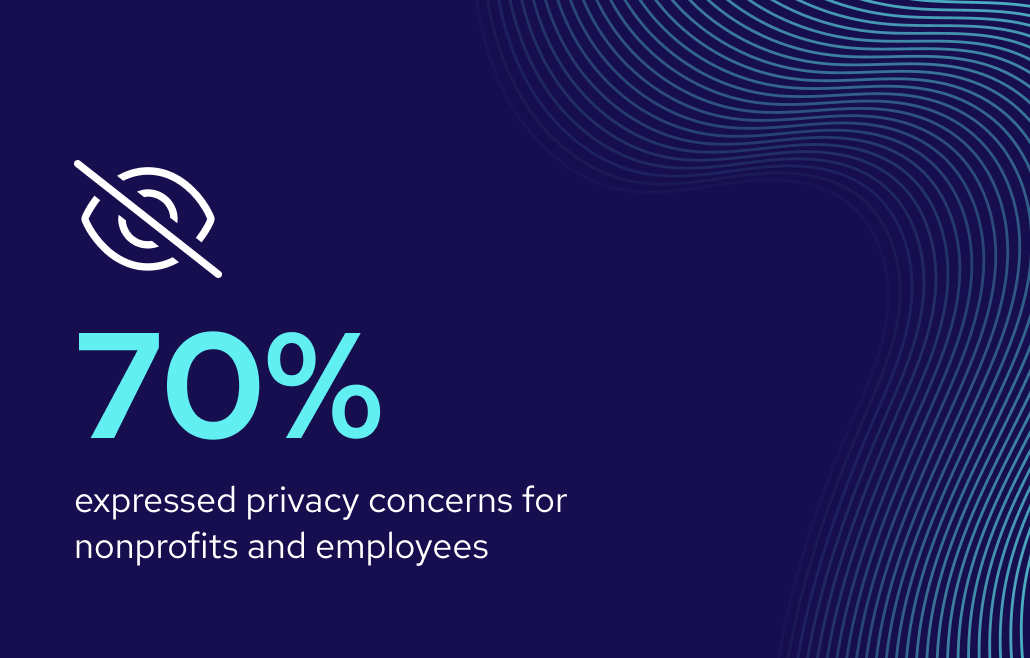
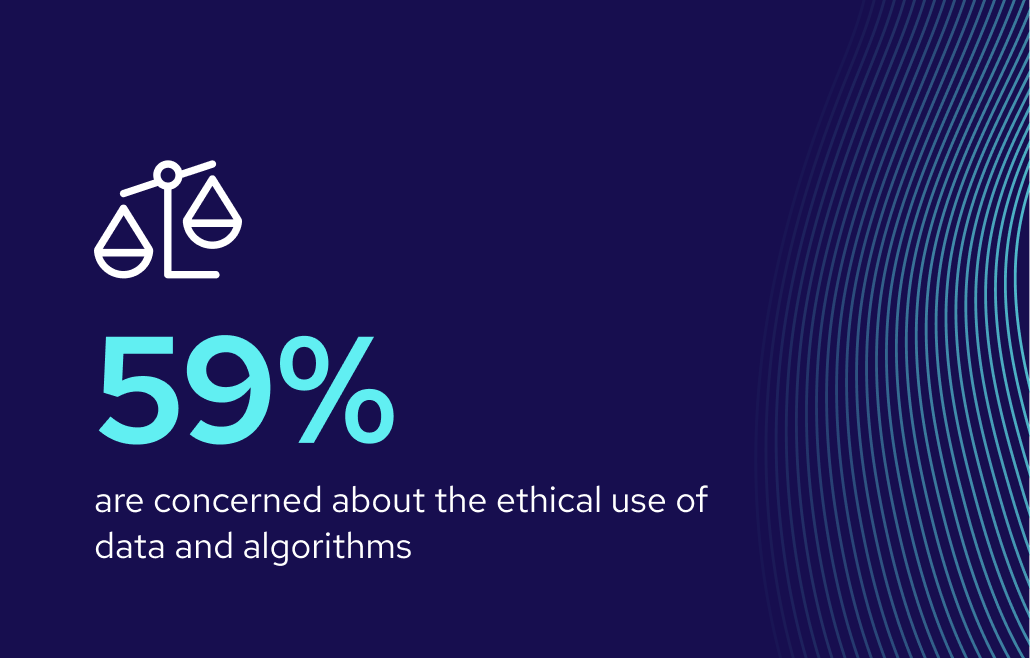
Large corporate firms also expressed serious concerns about AI's ability to equitably vet and recommend nonprofits.
Companies are drawing a clear line between using AI as a tool for efficiency and using AI as a decision-maker — only 23% of large corporate firms said AI should be used to decide grant approvals and denials. This will be welcome news for nonprofits, 51% of which are concerned about corporate donors using AI to score grant proposals, and 64% of which fear AI will miss the critical human nuance required to understand their true impact.
The employee experience is where optimism is strongest
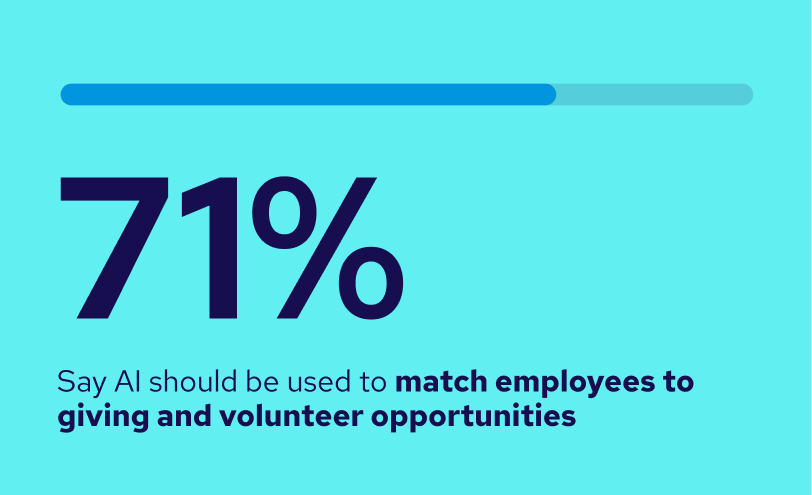
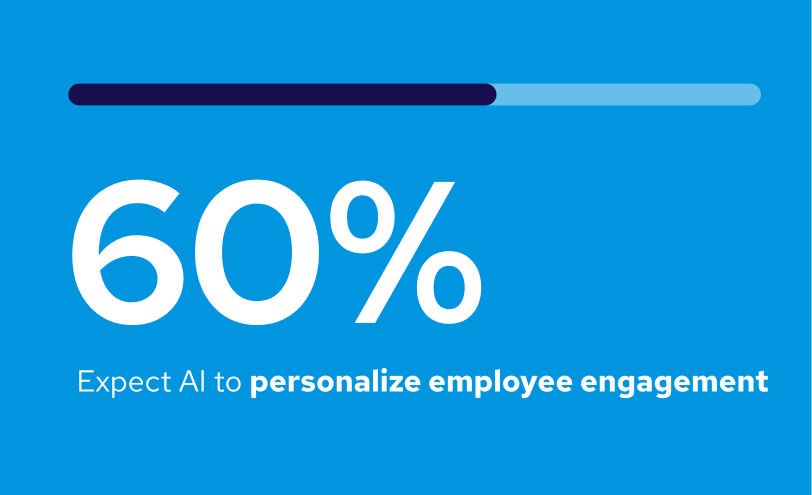
These are lower-risk, higher-reward applications. Matching an employee to a volunteer opportunity carries far less ethical weight than deciding which nonprofit gets funded. It's a pragmatic starting point, and one that could build organizational confidence in AI over time.

IBM is investing in the nonprofit sector’s ability to adopt AI responsibly through investments, skills development and implementation support. In collaboration with NationSwell, the company developed a freely available playbook, Responsible Use of AI for Social Impact, offering practical frameworks and guidance for nonprofits, funders, universities and technology partners navigating AI adoption. The initiative is grounded in a real gap: while the majority of nonprofits are using or exploring AI, 76% still do not have an AI policy in place. IBM's approach goes beyond a single engagement. Through programs like its pro bono IBM Impact Accelerator and free AI courses, assessments and digital credentials on IBM SkillsBuild, the company is building shared infrastructure that any nonprofit can access. The potential payoff is tangible: the playbook notes that nonprofits building AI fluency may see efficiency gains of 10-15%, the equivalent of a $100,000 unrestricted grant for a $1 million organization.
Acting on purpose
AI's role in corporate purpose is no longer theoretical. The challenge now is moving from experimentation to strategy without compromising the integrity of the funding ecosystem.
Here's where to focus:
Invest in AI capacity for nonprofit partners. Saying AI can help nonprofits run more efficiently isn't enough. Companies must back up that belief with funding, training or skills-based volunteering that helps nonprofit partners adopt the technology. One example of creating AI resources for nonprofits comes from the partnership of NetHope and Microsoft, who worked together to create a practical AI skill-building program for nonprofits.
Build shared infrastructure, not siloed solutions. When you invest in building AI capacity for nonprofit partners, the learnings are rarely relevant to just one scenario. Document what worked, what didn't and what surprised you, then share those insights with your other nonprofit partners or in a broader community context. Team4Tech proactively shares the outcomes and solutions from every skills-based project across their network of 2,000 nonprofit members.
Watch for siloes where there should be collaboration. As more companies fund AI initiatives for nonprofits, there's a growing risk of duplicated effort without shared learnings. If your company is funding AI capacity building, talk to other funders in your space about what they're investing in. Coordination doesn't require a formal coalition. Even informal information sharing can prevent nonprofits from navigating overlapping programs with conflicting requirements.
Volunteering is ready for its next act

96% of large corporate firms list employee engagement as a top reason to invest in volunteering
Corporate volunteering is surging, with record rates of employee participation, hours and skills given, and unique volunteers. This is largely the result of a hyperfocus on volunteering to rebuild culture and connection since "return to office" policies after the pandemic. With all of this success, and in a tight economic environment, it's unsurprising that 50% of companies are increasing their investments in employee volunteering programs. At the same time, nonprofits rank volunteering below funding as a priority on multiple fronts.
So, should we press on or should we pause?
Corporate impact leaders are consumed by finding links to hard metrics that prove the business value of their investments. Many want to deepen impact through team-based and skills-based volunteering. Nonprofits could benefit from the skills, corporate relationships and new donations that come along with employee volunteers. There is strategic alignment here, and an indication that volunteering deserves to be at the top of the corporate agenda.
For large corporate firms, volunteering is an HR strategy
When asked why they invest in volunteering, large corporate firms ranked HR outcomes at the top of their list. Community impact and supporting nonprofits is less of a motivating factor. This tells us something about how large companies are framing volunteering internally: it's a people strategy first, and an impact strategy second.
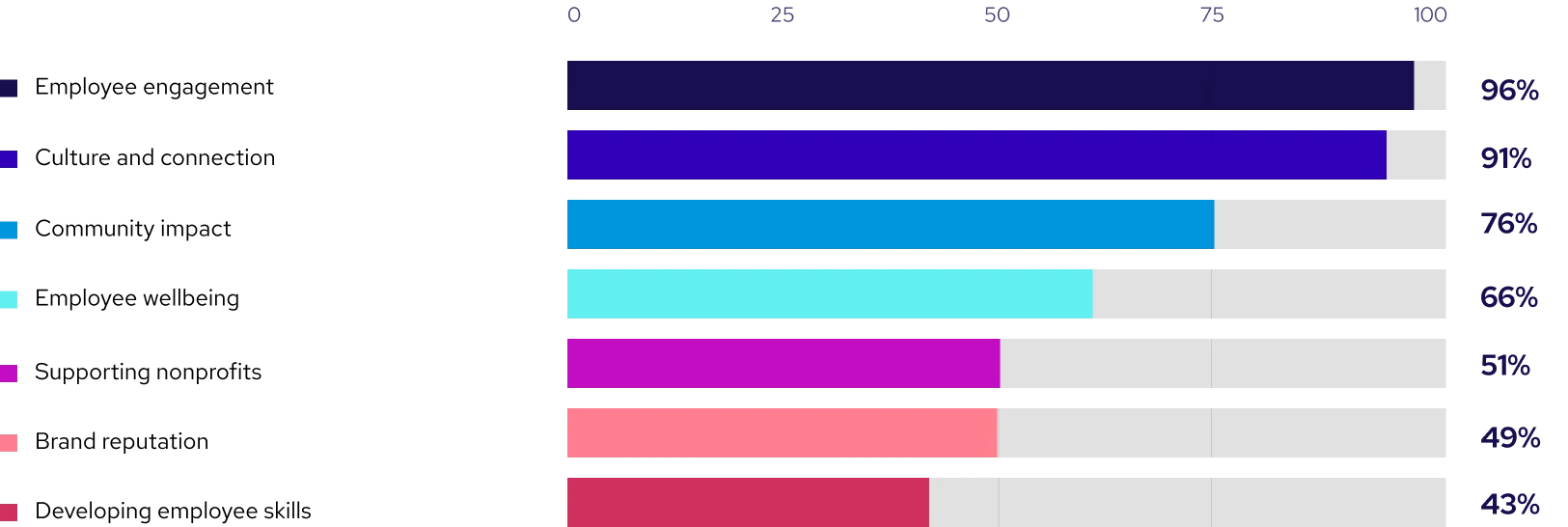
Volunteering is a top investment for companies, but not a top focus for nonprofits
While companies are deploying large volunteer teams as a culture-building mechanism, 50% of nonprofits say large, team-based volunteering events provide little or no long-term capacity, and 41% say corporate volunteer engagements rarely or never lead to significant financial donations or long-term funding partnerships. There is a clear divergence between corporate investment priorities and nonprofit focus areas. While companies rank employee volunteering and skills-based volunteering in their top five areas of increased spending, nonprofits have their attention on funding.
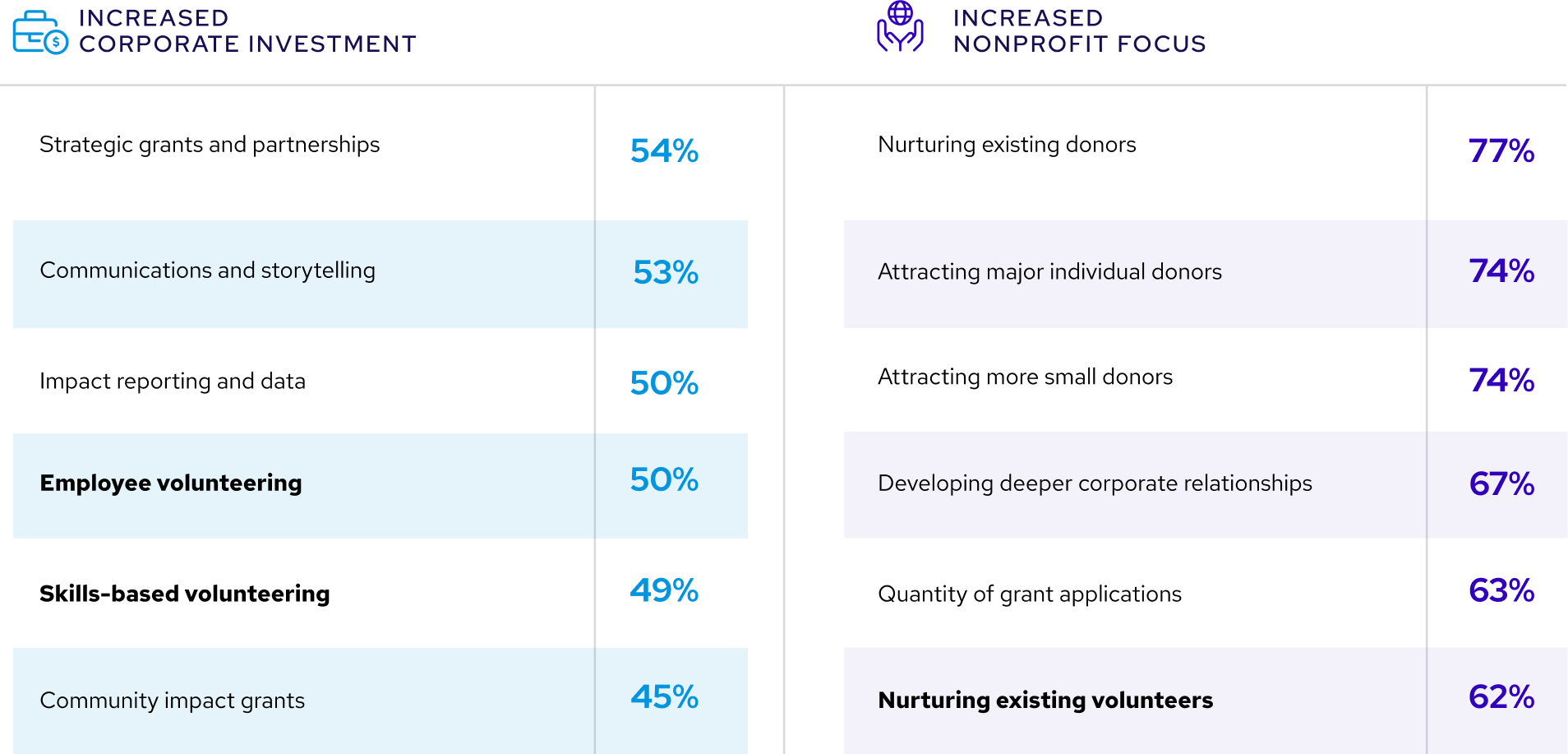
This divergence doesn't mean volunteering lacks value for nonprofits. It means that in a period of funding uncertainty, many nonprofits are prioritizing revenue. For companies investing more in volunteering, this tension is worth understanding. The enthusiasm on the corporate side needs to be matched by a genuine effort to make volunteering useful for the organizations receiving the volunteers.
Companies want to prove volunteering's business value
With increased investment comes increased pressure to prove what it's worth. Large corporate firms are prioritizing advancements in how they measure the business return on volunteering.
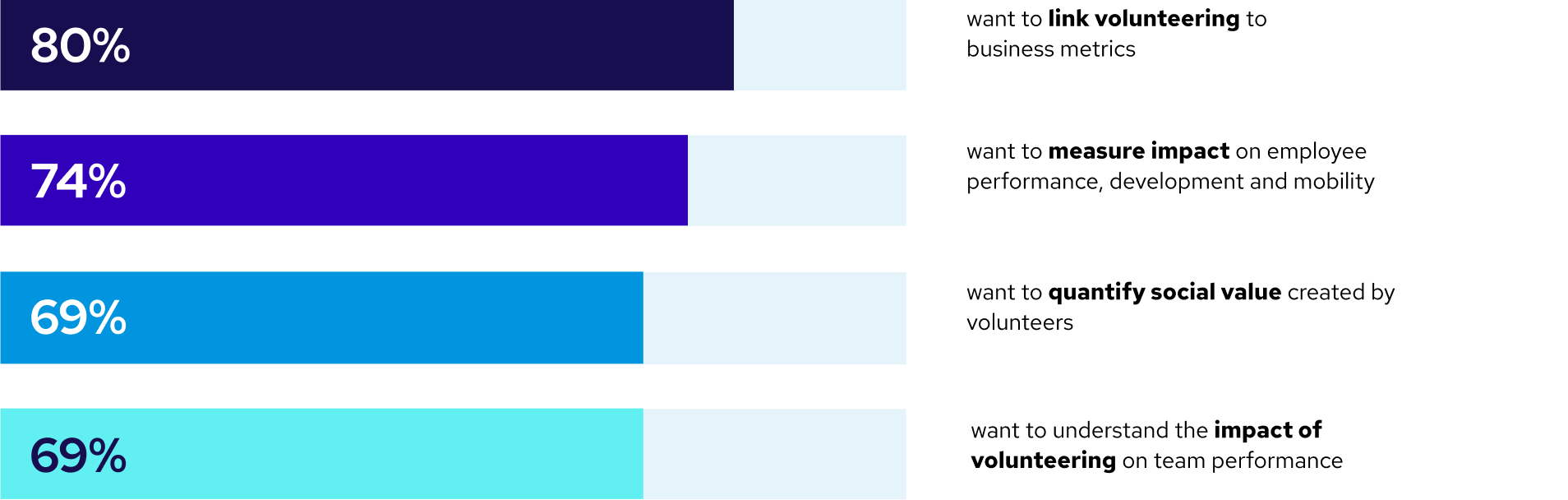
The demand for measurement is consistent with a broader trend across the sector: the pressure to justify every investment with data. Volunteering, which has historically been measured by hours logged and participation rates, is now being held to a higher standard.
A new "why" for volunteering is emerging
While social connection is still top of mind, more companies are rethinking what their volunteering programs are best used for. Beyond engagement and culture building, a new rationale is taking shape: developing the critical human skills that will matter most as we navigate massive workplace disruption and transformation prompted by AI.

There is a meaningful evolution happening here. If volunteering becomes an embedded learning and development tool, it more easily justifies increased investment and leads to business-aligned outcomes. And when smartly paired with the right nonprofits, volunteering investments becomes even more impactful.

UPS is demonstrating what volunteering looks like when it's designed for an entire workforce. In 2025, the company completed a global rollout of its UPS Community Connections platform, giving all 460,000+ employees worldwide access to volunteer and donate for the first time in The UPS Foundation's 75-year history.
The result is a stronger, more connected culture of service. Last year, UPSers contributed more than 1 million volunteer hours, and the company is tracking how that participation supports both its communities and its people:
- 80% of UPSers reported that their volunteer project positively affected their mental health
- 82% of UPSers reported that they feel proud of UPS because of its commitment to community service
- 900 UPSers reported their volunteerism contributed to their career growth or visibility
- 991 UPSers reported their volunteerism supported both networking and career advancement
- 1,025 UPSers reported their volunteerism enabled them to learn a new skill
By empowering their community relations managers and ambassadors to translate global strategy into relevant local action, UPS met it's 2030 goal of 30 million volunteer hours five years ahead of schedule.
Acting on purpose
Volunteering is at a turning point. Record participation, increased investment and a new rationale tied to human skills development all point to a program area with real momentum. But the disconnect with nonprofit priorities and the pressure to prove business value mean that momentum alone won't be enough.
Here's where to focus:
Bridge the gap with nonprofits. Before scaling your volunteer programs, talk to your nonprofit partners about what they actually need. Design programs that solve real problems or create meaningful opportunities for both sides.
Fund nonprofits like a service-providing vendor. Nonprofits invest real time and resources to host corporate volunteers, from designing activities to managing logistics to following up afterward. Yet most companies treat volunteer time as compensation enough, even though many nonprofits primarily engage in volunteer opportunities in hopes that it will lead to funding. Nonprofit partners offer many of the same planning, support and experiences as paid vendors, with more limited resources, so companies should consider building hosting fees or volunteer event grants into their program budgets.
Position volunteering as a learning and development investment. The data on human skills development gives volunteering a new business case. Build strategic alignment with talent and learning teams to build volunteering into employee development plans, performance conversations and leadership programs.
Measure what matters. If your goal is to prove volunteering's business value, invest in measuring the outcomes that matter: team performance, employee mobility, skills development and social value created for communities. When Cisco wanted to quantify the value of their purpose program for employees and the business, they worked with their internal Research and Intelligence team. They found participation was linked directly to higher bonuses, lower attrition, higher promotion rates and more peer recognition.
The new purpose playbook starts now
The first half of this decade tested corporate purpose in ways few could have predicted. And yet, purpose endured. Companies committed, leaders navigated a charged environment with skill and resilience, and purpose became more deeply rooted in business.
But it’s clear that the next phase of corporate purpose demands more than persistence. It demands intentional investment in the systems, partnerships and infrastructure that make purpose durable. That means grounding strategy and storytelling in real nonprofit outcomes. It means adopting AI where it adds value while keeping human judgment where it matters most. It means closing the gap between corporate enthusiasm for volunteering and what nonprofits actually need, along with an eye to building the human skills that the future workforce will need. And it means enabling the nonprofit ecosystem to report at scale as a partner in building long-term social and business value.
For executives, the question is no longer whether to invest, but how to invest in ways that make business more resilient in the face of political, economic and social disruption. This is the moment for business to shift from defending purpose to designing its future. 2026 is the year the new playbook for purpose-driven business gets written. Now is the time to write it together.

Methodology & Sources
This report synthesizes findings from research conducted by Benevity between September 2025 and April 2026. The study utilizes a dual-perspective framework to better understand the social impact ecosystem from the perspectives of professionals on both sides of the equation – the funding organizations and the nonprofits.
Impact Professional Survey
Between December 15, 2025, and January 9, 2026, an online survey of corporate impact professionals was conducted by Benevity Impact Labs. The research comprised 50 multi-part questions designed to capture the evolving attitudes and perceptions within CSR and purpose-driven business. The survey collected a total of 420 responses across two distinct cohorts:
- Large corporate firms (108 respondents): Benevity clients primarily representing large enterprise firms and corporate foundations with annual revenues exceeding $1 billion. This group serves as a reliable benchmark for the priorities, governance standards and reporting expectations of large multinational companies. There were no geographic limitations on clients. All were invited to participate in the survey.
- Small to mid-size organizations (312 respondents): Primarily representing mid-sized organizations with annual revenues under $1 billion. Notably, over a quarter of this panel consists of private foundations, reflecting a segment of the industry that operates with somewhat different structures, obligations, expectations and resource allocations compared to their larger counterparts. This general population panel group was weighted geographically to reflect the regional distribution of Benevity clients. The markets surveyed were from the following set: US, Canada, UK, France, Germany, Australia.
Nonprofit Perspectives Survey (May 2026)
The survey was originally fielded from March 31 to April 17, 2026. It targeted nonprofits that had received funding in the past 12 months across 13 countries. Of the 250 organizations that started the survey, 165 completed it completely. Responding organizations were headquartered in the USA, Canada, India, the UK, Ireland, Switzerland, France, Singapore, Germany, and Spain, with scopes of impact ranging from city/community to regional/provincial, country, and worldwide levels. Respondents could select all applicable missions from a list of 25 distinct cause categories and there was broad representation.
FY26 Nonprofit Experience Survey (October 2025)
The survey was in the field from September 3 to October 15, 2025, and was distributed to nonprofits worldwide through the Benevity Nonprofit Newsletter, direct email, and webinars. In total there were 1,458 responses. Participating organizations spanned the United States, Canada, Germany, France, Italy, Spain, the United Kingdom, Switzerland, and Portugal, and reported operating at city/community, region/state, country, and worldwide levels of impact. Respondents identified their primary mission across 25 cause categories with, once again, broad representation.
In capturing the attitudes and perceptions of these organizations, the research efforts offer a balanced look at the nonprofit landscape, providing a critical counterpoint to corporate-side trends and highlighting the practical realities of social impact delivery in 2026.