
Key takeaways
CSR has become an enterprise-wide strategic function, but team sizes haven’t scaled with expectations.
Data from the 2025 State of Corporate Purpose Report from Benevity shows the median CSR team size is just two — four people for most mid-to-large organizations and 54% of CSR leaders are considering leaving their roles.
Even a CSR team of one can scale responsibly by prioritizing, systematizing and securing executive support.
The role of corporate social responsibility (CSR) leaders has expanded significantly. Today they guide internal strategy, support employee resource groups (ERGs), navigate regulatory considerations, advance environmental, social and governance (ESG) reporting and deliver giving and volunteering programs that create meaningful social impact. And they’re doing it with remarkably lean teams.
Data from the 2025 State of Corporate Purpose Report from Benevity shows that in companies with 10,000–50,000 employees, the median CSR team consists of just four people—highlighting how much impact small teams are able to drive across large organizations.
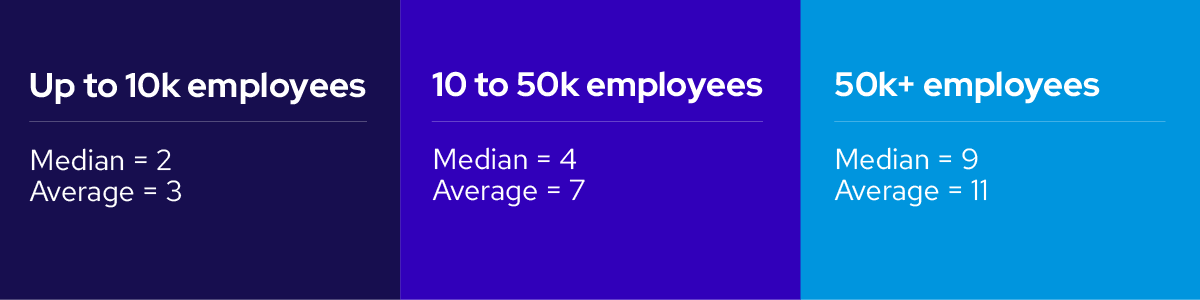
With lean headcounts and expanding expectations, CSR professionals are often asked to operate at enterprise scale without enterprise infrastructure. This misalignment between headcount and expectations creates a performance gap that can put CSR program quality and the sustainability of its long-term impact at risk.
2025 State of Corporate Purpose Report
At the same time, CSR teams find themselves consulting with an average of 10+ departments, including:
- Human resources: 59%
- Corporate communication: 67%
- Legal: 55%
- Risk and compliance: 58%
- Diversity, equity and inclusion (DEI): 59%
- ERGs: 57%
The scope of CSR work within an organization has expanded dramatically. But the data shows that the staffing hasn’t kept up.
{{divider}}
The compounding cost of CSR team instability
What the data says
The 2025 State of Corporate Purpose Report from Benevity shows:
- 51% of teams experienced a departmental or leadership change in the past year
- 26% of leaders in large enterprises lack confidence in executive leadership’s ability to make sound decisions on challenging issues
- 54% say risk, regulations and polarization are affecting their well-being
These numbers point to more than fatigue. They reflect instability, uncertainty and growing pressure at the exact moment CSR functions are being asked to guide organizations through complexity. Not supporting a small or CSR team of one will lead to lost business value and a potential loss of a valuable employee.
When turnover grows and confidence dips, the impact compounds:
- Institutional knowledge walks out the door
- Community and nonprofit relationships weaken
- Strategy resets delay progress
- Employees lose clarity and momentum
- Future business gains are lost, setting the organization back immensely
Burnout doesn’t just affect individuals. It disrupts continuity, weakens governance and increases reputational risk.
If CSR programs are intended to build trust, resilience and long-term value, then protecting the people leading that work is not optional. It’s operationally critical.
{{divider}}
CSR teams drive value — if you give them support
CSR initiatives shape external perception. According to the Edelman Trust Barometer, trust remains one of the most important drivers of brand resilience and stakeholder loyalty.
Purpose-driven programs managed by CSR teams act as a catalyst for employee engagement. When employees are empowered to participate in ways that matter to them — whether through ERG participation, volunteering, giving or simply working for an organization that invests in making the world a better place — they move from passive observers to active stakeholders.
{{quote-1}}
As Brian Tippens from Cisco, and many other Benevity Live! speakers and Speaking of Purpose podcast guests have shared, strong employee engagement and participation is one of the most common signs of a thriving workplace culture. And the business case for this is clear. Gallup reports that companies with highly engaged teams outperform their peers, delivering 23% higher profitability, 18% greater productivity and 10% more customer loyalty. The link to well-being is equally strong, with engaged workforces reporting 78% less absenteeism.
Supporting CSR teams isn’t just compassionate leadership. It’s a strategic business move that supports the triple bottom line philosophy.
{{divider}}
4 Strategies for team-of-one success
Even as a CSR team of one, you shouldn’t have to choose between impact and sustainability. Below are four practical ways to make the most of the resources you have while protecting your capacity.
1. Prioritize with discipline
Small teams can’t execute every stakeholder request equally.
Create a prioritization framework based on business impact, employee engagement, risk mitigation and reporting requirements. When you give yourself space to step back and think it through, the tradeoff becomes clear: a few programs done well build far more trust than a long list you’re struggling to maintain.
2. Build productivity through systems
Manual processes quietly fuel burnout.
If you’re relying on:
- Spreadsheets for tracking
- Email inboxes for grant workflows
- Disconnected tools for reporting
You’re spending strategic energy on administrative lift. A centralized platform, such as the Benevity Enterprise Impact Platform, can streamline and automate donation and matching program processing, streamline volunteer event planning, automate report generation and grant approvals.
{{quote-2}}
Systems create breathing room. Breathing room creates more time for strategic planning and high-value work.
3. Get executive buy-in and cross-functional support
CSR work thrives when it’s a team effort. Treat impact as a shared responsibility across the entire organization. Secure executive sponsors who:
- Advocate for resources
- Remove roadblocks
- Reinforce strategic alignment
Formal partnerships with HR, DEI, legal and corporate communications can help distribute workload and increase resilience. At the end of the day, shared ownership of CSR work protects team capacity.
4. Redefine success as consistency
Growth doesn’t have to mean adding something new every quarter. For a solo CSR lead, the expectation to launch a fresh initiative every quarter can feel exhausting and unrealistic. Sustainable impact is built through steady progress, not constant expansion.
Build your key performance indicators (KPIs) around:
- Participation rates
- Engagement quality
- Repeat involvement
Set goals aligned with realistic capacity. Sustainable, repeatable programs build more business value and stakeholder trust than constant reinvention.
{{block-cta}}
Sustainable impact starts with support
A CSR team of one or a few can deliver extraordinary impact. Many already are. And while burnout is very real, it’s not a personal weakness. It’s a structural signal.
According to the Benevity 2025 State of Corporate Purpose Report, 88% of leaders say their impact strategies are future-proofing their business. That only works if the teams leading that work are supported in return.
If you’re looking to build productivity through better systems and scale responsibly, there’s support available. Explore how the Benevity Enterprise Impact platform helps small CSR teams unify giving, volunteering, grants and ERGs in one platform.
Finding strength together in purpose-driven work
About the author