Key takeaways
Risk management in grantmaking is no longer a back-office function. From political exposure to cross-border compliance, granting organizations moving money in 2026 means treating risk as a core operational competency — not an afterthought.
Responsible AI for grant programs requires a framework. The grantmakers that will succeed with AI are those who invest in governance first — defining where AI adds value, where bias must be actively monitored and where human judgment is non-negotiable.
Nonprofit financial health is a shared responsibility. As a corporate grantmaking best practice, applying due diligence proportional to actual grantee risk creates space for honest conversations about financial health, earlier identification of trouble and smarter structuring of support.
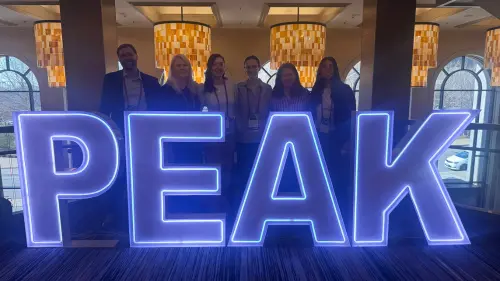
The 2026 PEAK Grantmaking conference, recently held in St. Louis, is the kind of conference where the sessions get specific. Under the theme "Rooted in Purpose, Rising Together,” the conference brought together grants professionals, foundation leaders and corporate philanthropy staff focused on the practical realities and complexities of running grantmaking programs.
Over the two and a half days, there were three themes that kept surfacing across sessions: how foundations are managing risk in a more volatile environment, how they’re thinking about AI in a way that’s actually useful and how to hold the line on compliance without losing sight of the relationships that make grants work. None of these are new topics. But the conversations felt more urgent — and more practical — than in previous years.
These trends map closely to what we hear from our corporate grantmaking clients, foundations and nonprofits every day: the growing complexity of international grants, the promise and peril of AI adoption and the need to fundamentally rethink financial due diligence.
Trend 1: Risk management has become a core grantmaking competency.
In a tumultuous year, it’s not surprising that risk management was top of mind as a grantmaking best practice.
Political Risk: Protecting funders and grantees
“Preparing for Politically Motivated Attacks — Protecting Funders and Grantees,” led by speakers from Alliance for Justice, addressed something many grantmakers are navigating but few talk about openly: the growing exposure that comes from funding advocacy, equity-focused work and community-led organizations in a politically contentious environment.
The guidance was practical: keep up with legislation and executive orders, leverage lobbying strategically and anticipate the narrative before it emerges. The smaller, locally-led nonprofits that foundations fund, the ones working closest to the communities, can be one of the most compelling data sources. In the end, robust reporting, staff training and coalition-building were suggested as grantmaking best practices to be nurtured.
International compliance risk: Navigating two sets of grantmaking rules at the same time
“Navigating International Grantmaking: Data and Direct Giving Strategies with Equivalency Determination and Expenditure Responsibility” featured leaders from JPMorganChase, NGOsource and the Council on Foundations and unpacked how much regulatory complexity is involved in moving money across borders.
When funds are sent internationally, two sets of rules apply simultaneously:
- U.S. regulations govern what leaves, requiring compliance with treasury sanctions, OFAC screening, IRS requirements, anti-money laundering rules, etc.
- The laws of the recipient country govern what arrives. These vary by country, change with governments and carry real legal and reputational risk when handled incorrectly or inconsistently.
The complexity of global giving means grantmaking best practices must include awareness and alignment with the two primary direct international giving mechanisms: Equivalency Determination (ED) and Expenditure Responsibility (ER). Each requires documentation discipline and workflow consistency that Benevity was designed to support, but many grants management software solutions do not. For both grantmakers and grantees, there is a knowledge gap as they are asked to comply with laws they’ve never heard of, produce documents not required under their domestic law and follow procedures that differ across every funder they work with.
There are three key risk considerations as part of global grantmaking best practices:
Q: Do we know our grant program financial compliance exposure?
A: If your organization gives internationally, are your grants structured through an IRS-compliant pathway (ED or ER)? Is your due diligence calibrated to the actual risk profile of each grantee — by country, by organization type, by the nature of their work?
Q: Are we measuring the right thing and telling the right story?
A: Organizations asked to navigate complex processes and political environments can spend unplanned capacity on administrative burden.
Q: Is our grants management software solution absorbing complexity or passing it on?
A: The best global giving solution doesn't ask your team to become experts in Indian FCRA law or Chinese NGO registration. It handles that risk complexity as a platform capability and proves it with consistent disbursement success rates at scale.
Trend 2: Responsible AI in Grantmaking is all about how you use it
AI may be a buzzword, but it is here to stay and offers a huge opportunity for global grantmaking programs. “Bringing AI into Your Foundation: Practical Strategies for Responsible Adoption” was a standing-room-only mainstage session. Featuring David Geilhufe (CEO, Resilia), Laura Heiman (United Way of Greater Atlanta), Nina Lagpacan (Oceankind) and Hilary Cherner (BrightWorks AI), the session made it very clear that foundations are not facing a technology gap with AI. They are facing a methodology gap.
AI in grantmaking should be a cross-functional priority. It requires executive-level alignment on philosophy and strategy, driving organizational change as much as technological change. The sector’s most credible practitioners advocate for something Benevity has built into its responsible AI approach from the start. AI supporting foundation and corporate grantmaking should be embedded in workflow, governed by design and accountable to outcomes rather than activity.
Building new grantmaking best practices for AI should include exploring the following questions:
- What processes can be streamlined, benchmarked or more deeply analyzed with AI — and where is human judgment or response non-negotiable in the grants process?
- Who are the stakeholders who can contribute artifacts, expertise and documentation to help build the knowledge repository?
- What AI processes are already built into the grantmaking software in use?
Trend 3: Nonprofit financial due diligence by grantmakers needs a reset
A two-part session from BDO's Nonprofit and Grantmaker Advisory team, titled "Reframing Financial Due Diligence" Parts 1 and 2, presented by Jennifer Pedroni and Melissa Cameron, got right to the point: most foundations are not doing nonprofit financial due diligence well. At present, it can be either a checkbox exercise that tends to disconnect it from grant decisions, or it creates a compliance burden for grantees that tends to exceed what the risk actually warrants.
In 2025, government funding cuts, executive order-driven disruption and increased scrutiny created real financial fragility in the nonprofit sector. This makes not just nonprofit due diligence, but financial due diligence, as a grantmaking best practice, more critical in 2026. Knowing that cash reserves below one month are a serious warning sign, while reserves of 3–6 months indicate stability, can inform how support needs to be structured or restructured —especially when many grantees are operating closer to the former.
The BDO framework positions financial due diligence as a partnership tool, not a gatekeeping function. Done right, it creates a scalable, repeatable space for honest conversations about financial health, helps identify risk early enough to act and enables non-monetary support where it is needed. The approach they advocated was to apply the level of financial due diligence to the actual risk profile of the grantee. For example, a well-resourced university in a stable jurisdiction does not need the same scrutiny as a grassroots organization operating in a conflict zone with government contract exposure.
Understanding and adapting to financial due diligence risk in grantmaking means looking across internal and external factors including:
- INTERNAL: foundation or corporate processes, leadership and board risk tolerance, staff expertise, grant management system.
- EXTERNAL: grantee jurisdiction, audited financials, banking relationships, nature of the work.
When it comes to nonprofit due diligence, here are the three most commonly asked questions.
Q: What is nonprofit verification and what does it include?
A: Nonprofit verification is the process of collecting and reviewing an organization's documentation to ensure secure and compliant platform participation. This process layers upon initial validation and typically includes activities such as:
- Bank Information Review: Ensuring financial details are accurate.
- EFT Confirmation: Verifying Electronic Funds Transfer setups for secure donations.
- Terms of Use Adherence: Confirming the organization agrees to and follows platform guidelines.
Q: How does nonprofit vetting help companies make values-aligned decisions?
A: Nonprofit vetting is a deep dive into publicly available sources to evaluate how a nonprofit functions beyond basic platform eligibility. By utilizing additional screening services, this process provides companies with the necessary insights to make informed, values-aligned decisions about which programs and organizations they choose to support.
Q: What happens if a nonprofit is flagged for compliance issues?
A: If a nonprofit is flagged through monitoring or reporting, a formal investigation is launched to ensure they are using the platform compliantly. This process is managed by dedicated legal and compliance teams who conduct:
- Issue Review: Analyzing the specific concerns raised by platform monitoring or user reports.
- Transaction Monitoring: Auditing platform activities to identify and resolve compliance breaches.
Learn more about Benevity Due Diligence.
There is no doubt that the practical realities of running global grantmaking programs are changing. After two days of candid sessions, intriguing ideas and shared problem-solving, PEAK 2026 was a reminder that the hard parts of grantmaking don't have easy answers, but they're a lot more manageable when you're not working through them alone.
Explore more Grants Management resources:
- Learn more about Benevity's Grants Management software
- Assess your granting program with the Benevity Impact Index
Schedule a demo today
About the author