
Key takeaways
As purpose experiences a period of uncertainty, large corporate firms are largely holding their granting strategies steady, while mid-sized organizations are actively changing theirs.
Mid-sized organizations are leaning into trust, flexibility and feedback — the things nonprofits say they value most.
But the same mid-sized funders are also demanding more reporting, which risks pushing expectations onto grantees that the nonprofits can't realistically meet.
The data below draws from the Benevity Spring 2026 Nonprofit Perspectives Survey and the State of Corporate Purpose 2026 report research.
Grantmaking, like all corporate purpose programs, spent 2025 absorbing the shockwaves of the political and regulatory climate. As companies faced increased scrutiny, the work largely continued. 78% of companies said they continued their purpose work in the same way as previous years. But this doesn’t mean that nothing changed, especially for nonprofits. Companies reported that they made changes to which programs and nonprofits they funded (65%), required them to attest to compliance (63%) and reworked eligibility criteria (60%). That’s a lot of turbulence for nonprofits, but Benevity data shows that changes in grantmaking programs varied widely depending on the size of the funder.
Large corporate firms, which we define as large enterprises and corporate foundations with annual revenues exceeding $1 billion, have mostly kept their granting strategies consistent. Mid-sized organizations — those with annual revenues under $1 billion — are proving to be more nimble. Put the two side by side and a pattern emerges: in a period of uncertainty, it's those mid-sized funders that are adjusting.
Maintenance mode vs. active change
The clearest signal is how each group answers a simple question: are you planning to change your grantmaking strategy in the coming year?
Among large corporate firms, only 25% reported plans to change their approach. That’s just over half the number shown by mid-sized organizations, of whom 47% plan to change their grantmaking strategy. This is understandable. After a year of recalibrating in the face of external and internal scrutiny, holding steady can look like stability. But a strategy set before the landscape changed may not meet the new realities faced by corporate purpose programs and their nonprofit partners. Mid-size companies are treating uncertainty as a reason to adapt rather than a reason to stay the course.
Trust, flexibility and feedback
How mid-sized funders are adjusting matters. Three shifts stand out, and all three point toward a more responsive relationship with grantees.
The first is trust-based philanthropy, which reduces the conditions and controls placed on grantees. 66% of mid-sized organizations plan to increase these practices, compared with just 18% of large corporate firms. While trust is often cited as an important part of a grantor-grantee relationship, smaller funders are reporting a higher likelihood of operationalizing it.
The second is flexibility in the funding itself. 37% of mid-sized organizations plan to increase unrestricted funding. Among large corporate firms, only 16% plan to increase it and 12% plan to decrease it. Meanwhile, 82% of nonprofits rated unrestricted funding as very or extremely valuable, and 88% said the same of multi-year financial support. Flexible, dependable money is the single most requested form of corporate support — and smaller funders are leaning into it.
The third is feedback. Corporate grantmaking has long been a one-way street: grantors receive and vet funding requests, and applicants might never even get a response. Our data shows that 53% of mid-sized organizations plan to increase the feedback they give nonprofits on their applications next year. Among large corporate firms, that figure is 4%. For a nonprofit trying to improve its next proposal, feedback from a prospective funder can make all the difference.
The equity and community divergence
Despite some of the stark figures above, nowhere is the split in what each group funds wider than in equity-focused grantmaking. Across all companies, appetite for funding diverse-led, equity-focused nonprofits has been sliding for three years:
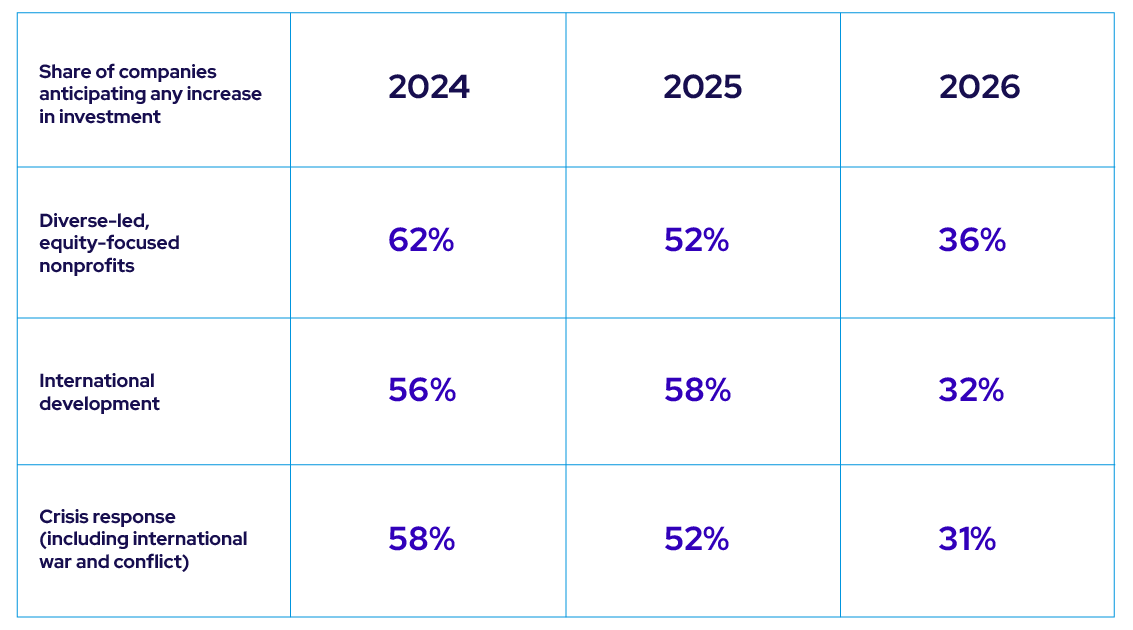
But the aggregate hides the divergence underneath it. Broken out by group, 47% of mid-sized organizations plan to increase funding for diverse-led and equity-focused nonprofits, against just 7% of large corporate firms — and 15% of large firms plan to decrease it. The same pattern holds for international development (42% of mid-sized organizations increasing vs. 4% of large firms) and crisis response (40% vs. 7%).
Comparing these numbers is not apples-to-apples. Large firms operate under scrutiny and public pressure that mid-sized organizations often don't. But whatever the cause, the effect on the ground is the same: for equity-focused and community-led nonprofits, mid-size organizations are increasingly where the funding is.
The other side of nimble: what mid-sized funders ask in return
Mid-sized organizations are moving toward trust and flexibility in how they fund, but there’s another side to the story. They are by far the more demanding group when it comes to impact reporting.
Suddenly, a nimble approach starts to cost the nonprofits on the receiving end.
51% expect to increase requests for real-time or continuous reporting, compared with just 10% of large corporate firms. 47% expect to increase requests for evidence of inclusive practices, against 10% of large firms. And while both groups plan to increase standardized outcomes reporting at similar rates — roughly 53% — mid-sized organizations also plan to increase custom reporting, at 54%.
That last combination is the trap. Pressing for standardized formats and bespoke, real-time, custom data at the same time leaves nonprofits with the worst of both worlds: universal templates to satisfy plus one-off demands to fill, from their most engaged funders.
And nonprofits are already operating at or over capacity. 48% of nonprofits absorb rising reporting requests through staff working overtime or unpaid hours, and when asked what would help most, 53% simply want funders to accept the standard impact reports they already produce rather than demand custom formats. Real-time reporting, in particular, assumes a data infrastructure most small and mid-sized nonprofits simply don't have.
Simply put, there’s a real risk that flexibility on the funding side gets quietly clawed back on the reporting side. Unrestricted dollars lose much of their value if the price of receiving them is a reporting workload that pulls staff away from the mission the funding was meant to support.
What this means for your program
There is context to be considered here. Large corporate firms and mid-sized organizations operate in different realities and can’t be held to the same standard. The nimble approach to grantmaking from mid-sized organizations offers a genuine playbook worth borrowing — and a cautionary tale worth heeding. Its best moves make grantmaking more responsive; its reporting demands show how easily nimbleness tips into asking too much of nonprofit partners.
If you run a grantmaking program, both sides are worth sitting with. Ask yourself:
- Are we revisiting our strategy this year, or living with one set before conditions changed?
- Are we able to offer the flexible, multi-year, unrestricted funding nonprofits tell us they value most?
- Do we share the results of funding applications with nonprofits, or leave them guessing?
- Are we escalating reporting demands faster than our grantees can meet them?
- Are we asking for impact reporting that we genuinely need, or would their standard reports serve us just as well?
None of this requires abandoning scale or scrutiny. Large funders carry real constraints the middle doesn't, and rigor in how grants are validated and governed is a feature, not a flaw. But the funders best positioned for a volatile decade won't simply be the fastest to adapt. They'll be the ones that stay nimble in how they give without passing that same pressure to the partners least equipped to absorb it.
Stay informed
About the author