Key takeaways
Time-bound matching, team leaderboards and tiered match pools create the urgency that turns Giving Season interest into action.
Employees give more when they can support the causes they care about and see the real outcomes their giving makes possible.
Year-round campaigns that show up in the tools employees already use set the stage for a successful Giving Season.
It’s Giving Season, the time of year when people are uniquely energized to give, volunteer, connect and create meaningful change in their communities and beyond.
This is a high-pressure time for impact leaders. Budgets are being scrutinized, employees and executives are racing to finish the year and participation goals for corporate impact programs keep increasing. When it comes to getting your people involved in your program, Giving Season is not the time to experiment. You want engagement strategies that are going to work.
Below are some of the top giving trends of 2026, and how you can use them to inspire your people to give.
Five corporate giving trends of 2026
1. Drive urgency with matching challenges
Matching is a common and powerful component of successful corporate impact programs. It amplifies every dollar donated and every hour volunteered and it shows employees that their company backs the difference they make.
During Giving Season, a few additions can take your matching program even further.
- Time-bound matching: Create exclusive time windows where matching is multiplied, like 2x matching for the next 48 hours. Or you can create themed matching days, where for a certain period of time donations to a set of causes trigger additional matching.
- Team competitions with leaderboards: Divide employees into teams, or let them compete as individuals, and recognize and reward the most giving in a set timeframe. Use motivational tactics like leaderboards and weekly updates to keep momentum high.
- Tiered match pools: Create benchmarks for your giving program, where new matching incentives are unlocked as donation totals rise. Throughout the giving period, share progress reports with your team to keep them motivated to unlock new tiers.
Pick the right strategic moment for elevated matching to see the impact grow, use countdown timers and live tracking to drive urgency and even set clear caps to make goals feel real and achievable.
Why matching challenges work:
- They create urgency, so employees act immediately
- Matches turn individual giving into a team-oriented, collective goal
- They show employees the difference they make in real time
See it in action: The Adobe Create Change program gave employees a clear reason and a simple way to act during its Season of Change campaign. The result was US$15.2 million donated to more than 5,700 nonprofits and a top 10 ranking among Benevity clients on Giving Tuesday.
2. Employee choice is expected
Many corporate giving campaigns center on a small number of pre-selected nonprofits. These lists often come from executives' favorite causes, legacy campaigns or other sources employees can't see into. The most successful programs go further. They let employees give to and volunteer with the nonprofits they choose, on a platform that makes search and discovery easy.
According to Fidelity Charitable, among employees who participate in workplace giving, 40% want a higher corporate match, 39% want a wider variety of programs and and 36% want more flexibility in the causes they can support.
- Open giving to any validated nonprofit: In your corporate impact program, include the nonprofits that your employees want to give to, without added risk. The Benevity Enterprise Impact Platform includes proven due diligence to reduce legal, financial and reputational risk, with more than 2 million validated nonprofits available.
- Allow employee-nominated causes: Go beyond employee choice and make your impact program employee driven. Give employees the opportunity to nominate causes they care about and build giving campaigns and volunteer opportunities around those causes.
- Inspire ERG-led giving: Employees often see employee resource groups (ERGs) as trusted groups within their organizations. Allowing them to lead giving campaigns, be involved in granting decisions and more can be a powerful lever for impact programs.
Why employee choice works:
- Creates a personal connection to causes that drives giving and volunteering
- Builds trust and autonomy with employees that their opinions and the issues they care about matter to their employer
- Sparks peer-to-peer momentum as colleagues share causes with each other
3. Impact stories inspire more giving
When employees regularly see proof that their giving program works, more of them participate. Responding to current needs matters, but showing what past efforts achieved is one of the best ways to inspire future giving.
Companies are putting money behind this. In the Benevity State of Corporate Purpose 2026 report, communications and storytelling rose from ninth place among budget increase areas in 2024 to second place in 2026.
- Share tangible outcomes from the past: Create annual reviews or quarterly reports that go beyond dollars given and hours volunteered. Show the real results of giving, like the number of meals delivered or medical procedures performed.
- Include nonprofit partners, without adding to their workload: Your nonprofit partners have the most powerful stories about what giving and volunteering make possible. The same report found that 44% of nonprofits face more requests for custom storytelling, and 49% say corporate donors rarely or never fund the extra effort. Ask for stories in ways that are easy for partners to provide, and consider funding the time it takes to produce them.
- Run real-time updates: Share live updates and milestones as your campaign progresses. When employees see their money doing good right away, they're more likely to give again.
Why impact storytelling works
- It shows employees that their giving and volunteering make an immediate difference
- It replaces abstract requests to donate with concrete outcomes
- It builds trust that your giving program is transparent and its results are easy to
Where to start if it's your first campaign
If this is your first Giving Season, start simple and use the resources below to make it easier.
For Benevity clients: The Giving Season resource hub has the guides and templates you need.
Available to everyone: Download the Giving Season Checklist for more ideas.
4. Multi-channel campaigns meet employees where they are
Your employees work from offices, homes, coworking spaces, job sites and everywhere in between. Cross-functional teams collaborate well without ever sharing a room. Your giving program needs to fit into that reality, showing up in the places and tools where work already happens.
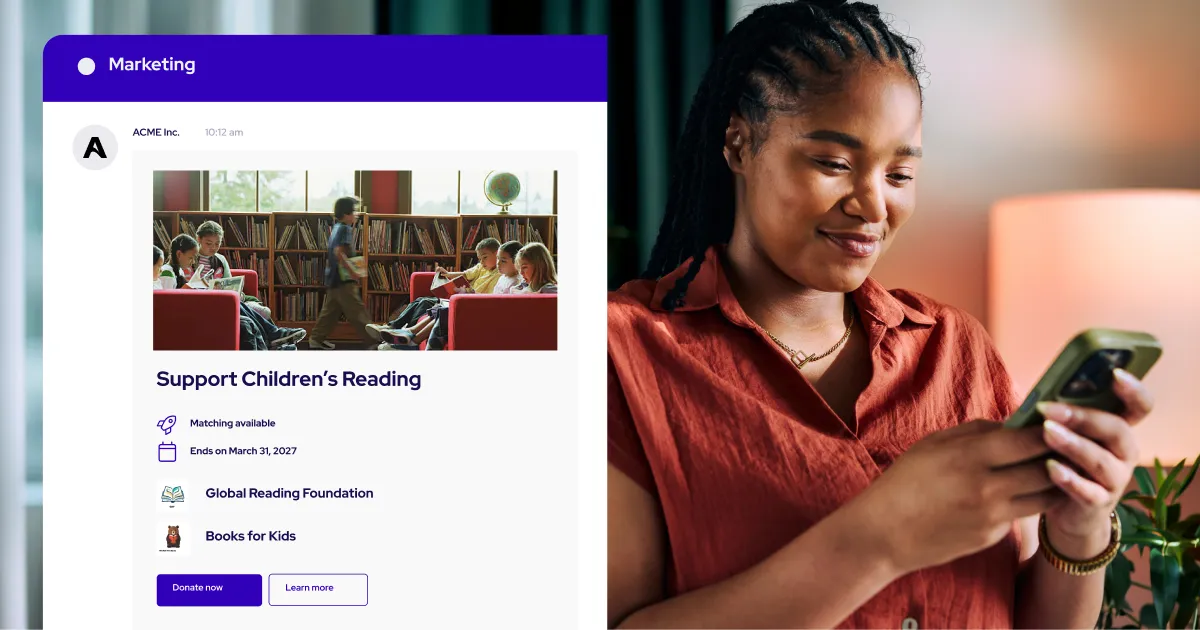
- Design mobile-first experiences: Make it easy for employees to donate and sign up to volunteer from their phones. Aim for a process that takes a minute or less.
- Integrate giving into your work tools: The impulse to give or volunteer often comes up during the workday, inside the tools employees already use. Benevity for Microsoft Teams lets employees donate, pick a volunteer shift and add it to their calendar without leaving Teams. A Slack integration and QR code access for employees who don't work at a desk are coming soon.
- Create manager toolkits and messaging: Give your leaders a playbook with consistent messaging and the tools they need to rally their teams.
Technology extends your reach, but personal connection still counts. Kick off campaigns in person when you can, and send video updates to keep your team connected throughout.
Why multi-channel campaigns work
- They create consistent reminders across every channel employees use
- They reach people who respond to different points of connection
- They make it easy to give in the moment, when the impulse strikes
5. Year-round engagement sets up Giving Season success
Giving and volunteering always rise during Giving Season, but lasting habits come from consistent action. Running programs and campaigns all year helps employees become regular contributors. It also keeps showing them that their participation makes a difference.
- Create quarterly themes: Launch campaigns throughout the year to keep participation steady. Make room for employee-led and ERG-led giving to build a cycle of trust and engagement across your team.
- Share regular updates: Between campaigns, keep your people informed with progress updates, nonprofit stories and data that shows what your program achieves.
- Design volunteer opportunities: Coordinated volunteer events throughout the year keep your team involved and build direct relationships with nonprofit partners.
Your most engaged employees are your best recruiters. Nominate them as program champions and give them the tools to bring more colleagues in.
See it in action: After the pandemic, Elastic saw giving peak during the holidays and then taper off. By replacing one-off campaigns with a consistent year-round strategy, Elastic increased employee donations by 92%, funds raised for nonprofits by 76% and the number of donors by 75%. Read how Elastic made giving a year-round habit.
Why year-round engagement works
- It makes employees more likely to take part when Giving Season arrives
- It builds good habits and familiarity with your programs and platform
- It turns giving into part of your culture, rather than a seasonal obligation
Make 2026 the best Giving Season yet
The companies seeing the most success this Giving Season make giving simple, meaningful and easy to share. Download the Giving Season Checklist for detailed next steps.