
Key takeaways
Return on investment (ROI) in giving programs is more than financial return, it's about the cultural, engagement and reputation value these programs create.
Turning impact into evidence starts with clear goals, the right reporting tools and effective storytelling.
Companies seeing the strongest ROI don’t necessarily spend more — they measure smarter.
Corporate giving is a proven driver of employee engagement, retention and reputation, with companies seeing a 52% decrease in turnover among new hires who participate in purpose programs. Yet, many CSR and ESG teams still struggle to demonstrate ROI beyond donation totals — not because their programs fall short, but because ROI is often measured too narrowly.
Measuring ROI in giving programs isn’t just about financial return or validation, it’s about demonstrating how purpose-driven programs strengthen workplace culture by engaging employees and elevate brand reputation and stakeholder trust through visible social impact — ultimately driving business growth.
To better reflect the true impact of their programs, CSR and ESG leaders should:
- Prioritize CSR storytelling by combining quantitative ROI metrics with human-centered stories to show purpose and measurable impact.
- Reinvest insights from ROI data directly into program design for continuous improvement and greater future impact.
- Use ROI data as a lever to strengthen stakeholder buy-in, secure executive support and increase budget allocation.
In this blog, we’ll break down how to define, track and communicate the full value of your corporate giving programs — so your results speak for themselves.
What ROI really means in corporate giving

In CSR, ROI includes both quantitative and qualitative outcomes. Tracking both provides a complete picture of program performance and turns ROI into a driver of influence, innovation and investment for corporate giving programs.
Quantitative metrics capture the tangible, measurable outcomes — including cost savings, productivity and operational efficiency — that show how giving programs contribute directly to business performance.
Quantitative metrics to measure:
- Cost savings from employee retention and reduced turnover.
- Productivity gains from engaged employees.
- Efficiency improvements through automation of giving, volunteering and grant processes.
Qualitative metrics capture the long-term, compounding benefits of corporate giving. These metrics go beyond the numbers and showcase the cultural and reputational gains — like a more engaged workforce and stronger community relationships — that strengthen brand equity and stakeholder trust.
Qualitative metrics to measure:
- Enhanced brand reputation and customer loyalty.
- Improved ESG ratings and investor confidence.
- Employer brand and talent attraction.
How to measure ROI in your corporate giving program
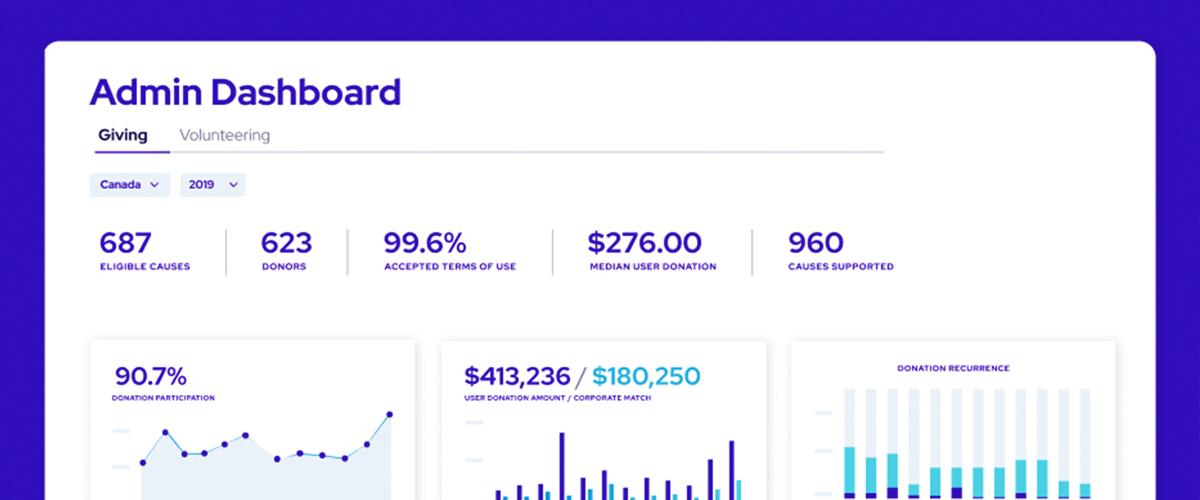
1. Define clear goals and key performance indicators (KPIs)
Every effective giving strategy starts with strong alignment. When your giving strategy ties purpose to business priorities, results become easier to measure and communicate.
CSR and ESG leaders should focus on:
- Setting KPIs that reflect your program’s missions (e.g., employee participation rate, donation growth, volunteer hours and nonprofit reach).
- Mapping each metric to a core business or ESG objective (e.g., DEI engagement, community impact).
2. Use technology to track and report impact
Manual tracking limits visibility and accuracy. Enterprise Impact Platforms simplify data collection and make impact transparent across teams.
CSR and ESG leaders should focus on:
- Integrating digital impact reporting tools to capture and analyze data in real time.
- Automating dashboards to consolidate data across giving, volunteering and grants.
3. Quantify engagement value
Employee participation is closely tied to stronger business performance. Engaged employees deliver 14% higher productivity — and when engagement is measured and translated into business terms, they build an impactful case for continued investment in CSR and ESG programs.
CSR and ESG leaders should focus on:
- Translating employee engagement metrics into monetary terms using industry benchmarks.
- Demonstrating the clear link between employee engagement and overall business profitability.
4. Translate social outcomes into business results
Around 76% of business leaders plan to increase investments in social impact initiatives over the next 12 months, and a 2022 survey from KPMG showed that 94% of CFOs expect social impact to be a top priority in 2030. CSR and ESG teams must connect community and social outcomes to measurable business results to showcase the full ROI of their giving programs, in a way that resonates with leadership.
CSR and ESG leaders should focus on:
- Converting impact metrics into financial terms, such as cost avoidance or revenue contribution.
Where corporate giving programs lose ROI
Even purpose-driven programs can miss the mark when measurement is off. Understanding common pitfalls can help CSR and ESG teams maximize both impact and visibility.
1. Misaligned goals or lack of baseline data
Without clear objectives tied to business priorities, programs can feel disconnected from purpose. Establish baseline metrics like employee participation rates and volunteer hours to track progress and demonstrate ROI over time.
2. Manual tracking that limits visibility
Manual tracking via spreadsheets or siloed systems can slow insight. Automating data collection through digital tools makes sure that key stakeholders have real-time visibility into program performance.
3. Over-reliance on donation totals without impact context
Focusing on dollars donated isn’t enough. Programs should also measure engagement and community outcomes. Providing context shows how giving translates into cultural and reputational value.
4. Failure to communicate wins internally and externally
High impact programs lose momentum if success isn’t shared. Regular reporting and storytelling to both internal and external stakeholders builds credibility, drives participation and strengthens brand perception.
CSR return on investment in action

Levi’s: Participation drives retention
When employees feel a sense of ownership in corporate giving, they’re more likely to stay and thrive.
Levi’s is a strong example of this in action. The company bakes purpose into everything they do — from onboarding new employees to ongoing initiatives aimed at engaging their people, customers and communities in social good.
Learn more about Levi’s social initiatives
Cisco: Data-driven storytelling builds trust
Cisco turns transparency into influence by combining quantitative data with compelling narratives. Using dashboards and narrative reports, the company gives internal leadership clear visibility into what’s working and where programs are having impact.
KPIs tied to ESG goals are also reviewed quarterly, making sure that CSR initiatives are aligned with business priorities and purpose — reinforcing trust with both leaders and stakeholders.
Learn more about how Cisco elevated social impact with Benevity
UPS: Linking CSR to brand reputation
UPS doesn’t just encourage employees to volunteer — the company publicly shares its giving, volunteerism and sustainability metrics to build confidence and loyalty among employees, customers and other stakeholders.
By connecting volunteer data to broader indicators like customer trust scores, UPS shows how measuring and reporting CSR activities can influence perception, reinforce company values and strengthen internal and external reputation.
Learn more about UPS’s commitment to their customers, people and communities
The future of CSR measurement: Turning purpose into performance

When purpose meets data, CSR becomes a strategic growth driver. The companies seeing the strongest ROI don’t spend more, they measure smarter. With the right tools and metrics, your corporate giving program can deliver both social good and business value.
Want a number for your own program? See what that ROI could look like for your program with our Business Impact Calculator.
Ready to measure and scale your impact?
About the author