Key insights
Uncovering the link between purpose and retention
Work as we know it has changed. In the past few years, people have grappled with various — often intersecting — challenges precipitated by the pandemic. It’s been trying, for both employees and businesses, especially during times of economic uncertainty.
Much of the focus has been on the skyrocketing number of employees who have left or changed jobs over the past few years. Then there’s “quiet quitting,” another indication employees are less engaged and reevaluating what they want — and expect — out of work.
To avoid repeating the same cycles of turnover, we need to start by asking why people are quitting, whether literally or quietly. There are a few reasons, including a need for flexibility and autonomy. But one critical factor, often overlooked, is they are searching for more purpose, meaning and impact at work. According to McKinsey, 31% of employees quit their previous jobs due to a lack of meaningful work.

Understandably, many companies have been focused on the employees who are leaving. Where there has been less focus is on the many new people being onboarded. With companies seeing such a large influx of new hires, it’s critical to consider why those people left their previous jobs and what companies can do differently to get — and keep — new employees engaged.
To understand the trend, we analyzed data from 10.6 million users at more than 400 companies on the Benevity platform, with a focus on people who had been with their company for 2.5 years or less — employees with a higher likelihood of being part of the Great Resignation or falling within the growing millennial and Gen Z workforce. Collectively, those two generations make up 46% of the full-time workforce in the U.S., with the average tenure for millennials and Gen Zers at just two to three years.
The data revealed a strong association between employees engaged in a company’s corporate purpose program — including charitable giving, volunteering and other positive actions — and heightened retention.
Purpose ascends the priority list in 2021
In the fall of 2021, there was a new peak in voluntary employee turnover. However, this trend has been building for the past 10 years, in part because millennials and Gen Zers care more about purpose than other generations do — and they are quick to move on when they don’t find it in their workplace. In fact, over half of Gen Zers say it’s very important for their work to have meaning, and 71% would take a pay cut to do more meaningful work. Even as trends like the Great Resignation move into the rear view, it’s clear that people still have different priorities when it comes to work, and purpose is high on that list.
Purpose is strongly linked to employee retention
There is a clear link between an employee’s participation in a corporate purpose program and how long they stay at a company — especially during their first 2.5 years.
For employees, corporate purpose programs have a strong relationship with their tenure. Even more so if they’ve been with the company for 2.5 years or less. Participating in these programs plays a role in shaping their early experiences with the company, as they assess whether the employer meets their promise around purpose, value and impact broadcast through brand messaging and recruitment — similar to how consumers evaluate the brands they purchase from.
As an employee integrates into the culture and has a broader set of experiences, purpose still seems to play an important role in their engagement — even six years out. That’s powerful when you consider the cost savings of engaging and retaining people who are longer tenured and have institutional knowledge and know-how. Purpose is not only formative for people in those early days with a company — it is a critical factor in engaging and retaining employees over time.
There’s also reason to believe these retention rates will change as Gen Z workers, whose sense of purpose is proven to be key to their engagement and retention, will make up a greater proportion of the workforce.
Reduction in turnover by employee cohort
This data reveals a significant opportunity for corporate social responsibility and human resources leaders. Engaging their people in their programs contributes to them having a positive impact at work and in the world. With 53% of Gen Zers saying it’s very important for their work to have meaning, and 80% of Gen Zers and 59% of millennials saying that better alignment with their values and interests is a priority for their place of employment, companies who don’t prioritize engaging their people in purpose could find themselves in the same cycle of high turnover again and again.
In 2020, we saw heightened activity on our platform in support of prevalent societal causes like racial justice and vaccine equity, reflecting a collective desire to create positive change. However, our analysis shows that in 2021, 65% of companies experienced a lower rate of employee participation in their corporate purpose programs than in the previous year, in part because these programs were feeling the effects of increased employee turnover.
With the influx of new people joining companies, rates of participation in giving and volunteering decreased, partially because it takes time for new employees to ramp up and fully engage with their companies’ corporate purpose programs. At the same time, reduced participation is correlated to increased turnover, which leads to more churn.
This all underlines how important it is to engage new employees early on.
The impact of purpose programs on retention is consistent across regions.
To further analyze the trend, we looked at how the impact of purpose programs on retention differs by region. We found very little difference, with the link between employee participation and the reduction in turnover being consistent, regardless of region. Perhaps this points to the universal human need to feel a sense of impact and purpose in our lives, of which work is a big part.

Reduction in turnover by region
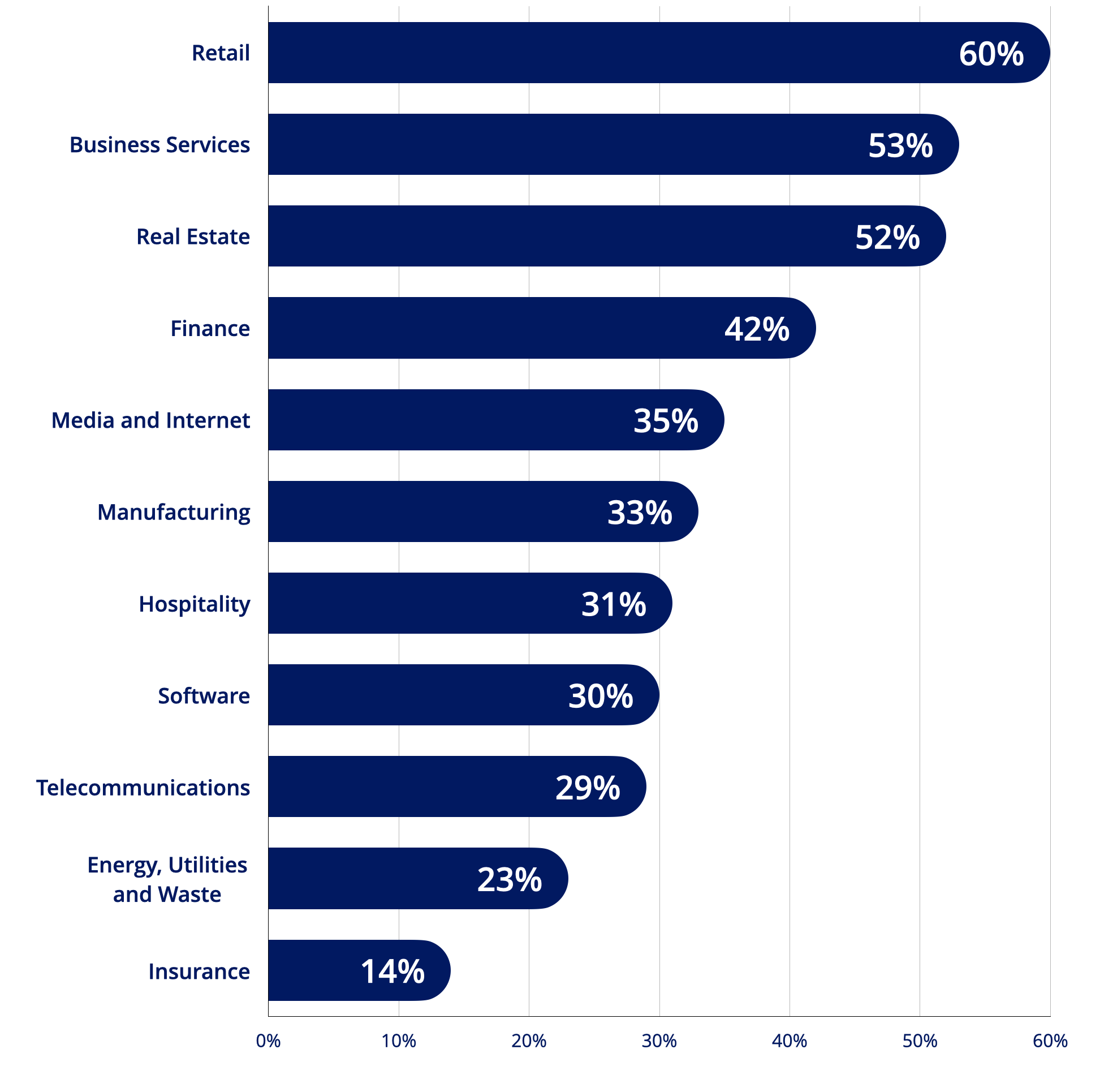
However, when we look at the data by industry, the impact on retention varies widely.
The impact of purpose programs on retention varies by industry.
Engaging employees in purpose early on positively impacts the bottom line.
It’s no secret that the cost of replacing talent can be high. Especially when looking for specific qualifications or skill sets. The impact a purpose program can have on improving a company’s bottom line, by reducing employee churn, cannot be underestimated.
The cost of replacing an entry-level employee is estimated to be around 30% to 50% of their annual salary. Go up a few levels, and you’re looking at 150% for mid-level employees and 400% for seasoned and specialized team members. And the value loss goes beyond the hard numbers. When people leave, team cohesion, morale and productivity are all impacted as teammates and adjacent workers try to fill the gaps.
Newer employees participate less than those with longer tenures
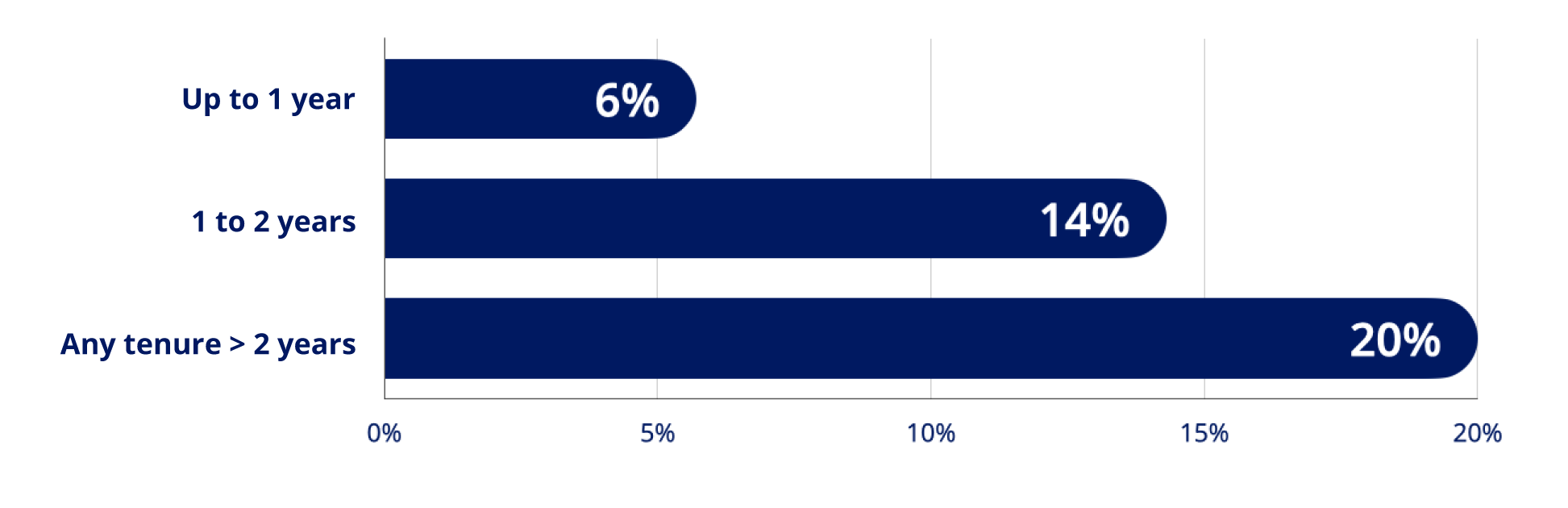
New employees participate in corporate purpose programs at a third of the rate of their longer tenured peers.
Our analysis shows that employees who have been with a company for under one year are less likely to participate in a corporate purpose program than their longer tenured peers. On average, these employees have a participation rate of just 6%, compared to 20% for employees who have been with a company for more than two years.
With Benevity data showing that 40% of employees in our client community have been at their company for one year or less, or they’re newly enrolled in their corporate purpose program, it’s clear companies must shift their approach to these programs to deliver on what new employees are looking for. Simply having a program isn’t enough.
New employees will likely be more motivated to participate if they are aware of the programs, feel connected to the company and their peers, and are able to engage easily in ways that personally resonate with them.
Employee participation by tenure
The reasons why new employees participate less vary widely.
Here are four common reasons new employees are less inclined to take part in social impact programs:
- They likely have fewer social connections at the company compared to their longer tenured peers, so they may not have heard about the program or could be less inclined to support employee-driven initiatives.
- New employees typically have less awareness of various company programs and initiatives, perhaps due to poor or inconsistent program promotion and communications.
- Many companies have transitioned to remote or hybrid work but have not adapted their programs and onboarding to account for this.
- Remote work, fewer in-person bonding opportunities and limited volunteer events — paired with an influx of new employees who have never met in person — all contribute to weaker social ties.
7 ways to engage your employees with purpose on day 1 (and beyond)
Engaging your people in your programs, early and often, is key to more participation and longer tenure. Here are seven proven tactics you can implement to involve your employees in purpose from the get-go and keep them engaged over time.
1. Infuse purpose into onboarding.
Make sure you're doing more than mentioning your program to new employees. To intentionally engage them, you could provide them with donation currency they can use in your program, or you could bring new cohorts together to volunteer online or in person. This is not only rewarding, but it gives new people a taste of how your program works, and they'll see the difference it makes by trying it out for themselves. If you offer donation currency, follow up with reminders to donate — people don't like to see goodness go to waste, but it can be easy to forget to use rewards. Also, keep in mind that your remote people may need more tailored and organized activities during onboarding and for their first 12 months on the job.

The result of engaging people early in their journey? Microsoft's employee giving program has generated best-in-class participation rates.
2. Communicate your company's contributions and commitment.
When people see that leaders value purpose, they do too. In fact, leadership involvement and communication about programs are two of the biggest predictors of participation and program success. This means it's important to communicate the purpose investments your company is making — like the grants or social impact projects you're funding — at company-wide or large events to demonstrate commitment from all levels within the business. It's also important, from a culture perspective, to use company-wide communication channels to highlight your company's investment in impact.
3. Activate middle managers.
These key employees can champion social impact activities while driving awareness on their teams. Some Benevity clients, like Starbucks, have their managers walk all new employees through their purpose program and systems so they understand the program right away. Managers can also thank and reward team members with charitable gift cards they can use to donate to causes they care about.
4. Tap into — and support — your affinity groups.
Affinity groups, or employee resource groups (ERGs), are a powerful driver for connection, as many people who join a new workplace want to find "their people" and get involved. By showcasing and amplifying the work of your ERGs and helping employees feel they belong at work, you can build a sense of community and impact early. Make it even easier by providing an online hub for all of your groups.
5. Use a mobile app or create a mobile computer station to reach remote workers.
Make your program as inclusive as possible by ensuring equal access for your desk- or device-less employees. You'll see participation grow while showing your people that an inclusive and equitable culture is important to your company.

6. Don't wait for your annual campaign.
Engage your people all year round, and use awareness dates like Black History Month and International Women's Day, as well as real-time events or crises, to let them know they have a way to act on the issues that matter to them. Then, empower your people by enabling them to post their own giving and volunteering opportunities to garner support from their peers. They could even use your program to send charitable gift cards to customers, prospects, vendors and other team members as a thank you.
7. Engage your people in corporate granting
Our research on stakeholder philanthropy shows that when it comes to how your company directs corporate funds and grants, your employees want to have a say. Get them involved by forming employee selection committees where they can help choose grantees, or even have them nominate grantees themselves. They could also help organizations complete their applications. Engaging your people this way helps them build skills and cross-functional relationships, which is good for them and your business. And, because many employees love learning and development opportunities, especially as it relates to the social impact space, this is a great way to get them involved without changing their day jobs.

The future of work starts with purpose
The new engagement challenges thrown at companies over the past few years are not to be underestimated. The good news is that if you already have a purpose program, you are well on your way to meeting these challenges head-on.
With more and more people searching for meaning at work — especially younger generations, who will continue to make up a larger portion of the workforce — the importance of purpose will only grow in relevance. Engaging all your people in your corporate purpose program early, in ways that are meaningful to them, is a significant opportunity to keep retention high while strengthening your company culture for everyone, everywhere.