Key insights
Businesses will adopt an “impact mindset”
In the fast-moving 2020s, it’s hard to catch our breath. The pace of change is unlike anything we’ve seen before, from COVID to climate change to ChatGPT.
This year, things will continue to move quickly and businesses will need to stay nimble to adapt. We’re living in an increasingly polarized world. People are divided by historic levels of war and internal conflict; by wealth and inequality; by unequal access to technology; and by different visions of the way forward.
This will also be a historic election year, with 2 billion people across 50 nations going to the polls in countries from the U.S. to India. There’s no shortage of division, change and unpredictability coming our way.
Between existential threats and rapid technological developments, companies will be revisiting their talent and culture and their operational and sustainability strategies to ensure that they can weather the sea of change. But that won’t be enough.
To get to the heart of the matter, they’ll need to question whether their corporate purpose is up to the task of addressing these headwinds, ensuring they can maintain relevance over the long term. Employees, consumers and even shareholders, expect a commitment to purpose and a positive impact. And perhaps more importantly, it's becoming more of a business-wide strategy versus something that's siloed in CSR.

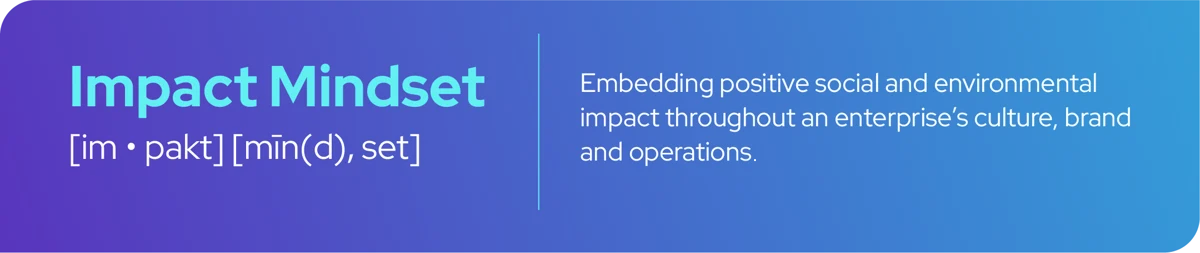
Embracing an impact mindset1 will give companies the opportunity to not only meet the moment, but to build resilience into their business, culture and communities. It’s an important step. It will lead us from the react-and-respond phase of the early 2020s to a more strategic and forward-looking approach.
The five trends we’ve identified in this year’s State of Corporate Purpose report are linked by a common thread — a more strategic and forward-looking approach to driving impact.
2023 in review: Businesses fueled impact
Corporate giving outpaced individual giving
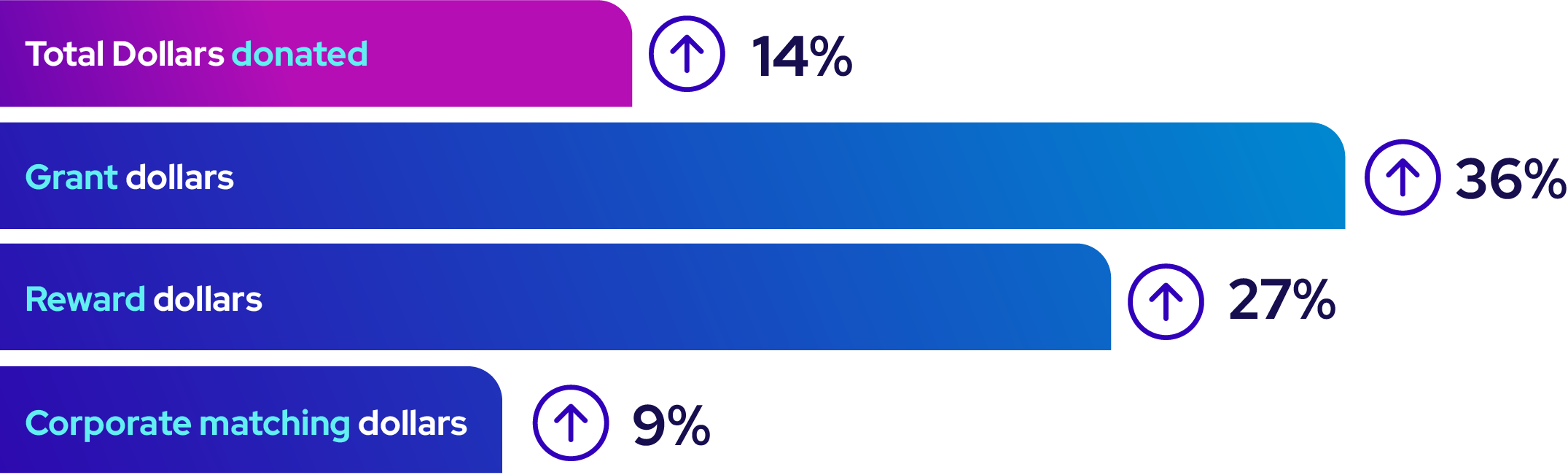
In a year marked by high inflation and recession worries, it's no surprise that while total dollars donated by companies and their people increased by 14%, individuals donated, on average, 9% less in 2023.
When the going got tough, companies stepped up
And this year, corporate investment in social impact isn't slowing down

Top 3 investment areas for social impact

Businesses are multiplying the impact of their people's gifts of time
Although employees are giving less of their own money, there's a silver lining. The surge in employee volunteering resulted in a boost in employees donating their volunteer rewards, in which companies match volunteer hours with dollars. There was a 27% increase in reward donations, from $250 million in 2022 to $318 million in 2023.
The takeaway
What we’re seeing gives us confidence that we can trust businesses to truly act as a force for good, especially in times of need. It’s encouraging to see 60% of companies now offering volunteer rewards to motivate and reward people for getting involved – but that means there are still a lot of opportunities for the other 40% of companies.
Strategic granting is back on the rise
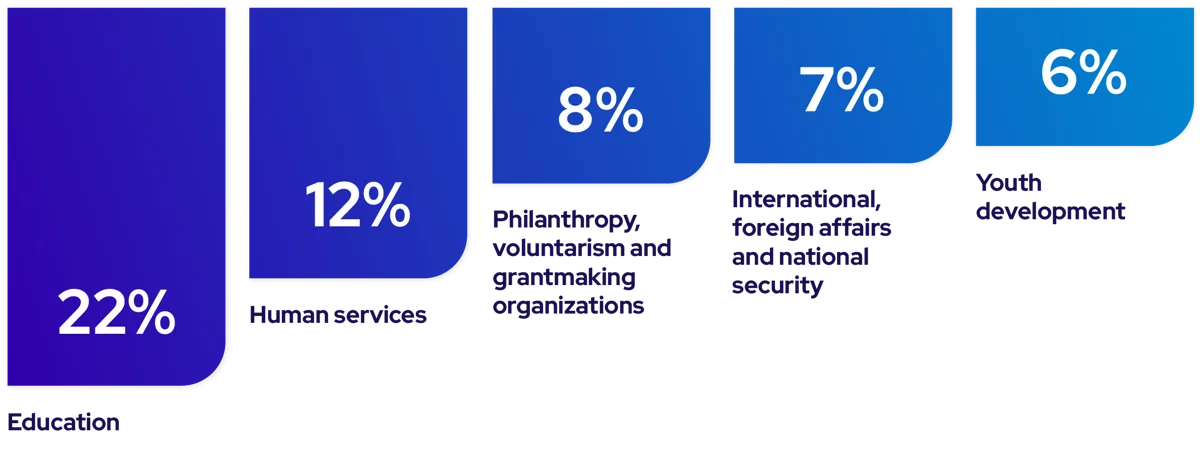
This year, companies are once again tying their impact strategy more directly to their core focus and corporate values. This marks a change from the trend that started in 2020, when companies were deploying more dollars towards crisis relief, such as helping communities weather the COVID pandemic and responding to racial justice movements. As part of that reckoning, many companies have now embedded a crisis and DEI lens to the full range of their granting programs, ensuring agility, broader access and greater accountability for the long term.
Top cause categories by grants dollars
The takeaway
The rise of strategic granting will create more long-term commitments, and possibly even new partnerships, that have the potential for greater impact and outcomes.
How ESG continues to evolve in 2024
As we near 2030 and the net zero targets set by many companies, we are seeing a growing urgency around the "E" (Environmental) in ESG. More environmental investments are being made through corporate philanthropic programs, and companies are increasingly partnering with nonprofits across the globe to fund environmental projects, support research and development of sustainable technologies and invest in conservation efforts such as reforestation. This is a way of both accelerating and diversifying their carbon offset, as well as expanding the footprint of their environmental commitments across their business culture and operations.
At the same time, as we've previously predicted, the distinction between the “E” and the “S” (Social) is continuing to fade. All indications point to growing regulatory, shareholder and stakeholder pressures that will have companies measuring, managing and reporting on the totality of their environmental and social initiatives.
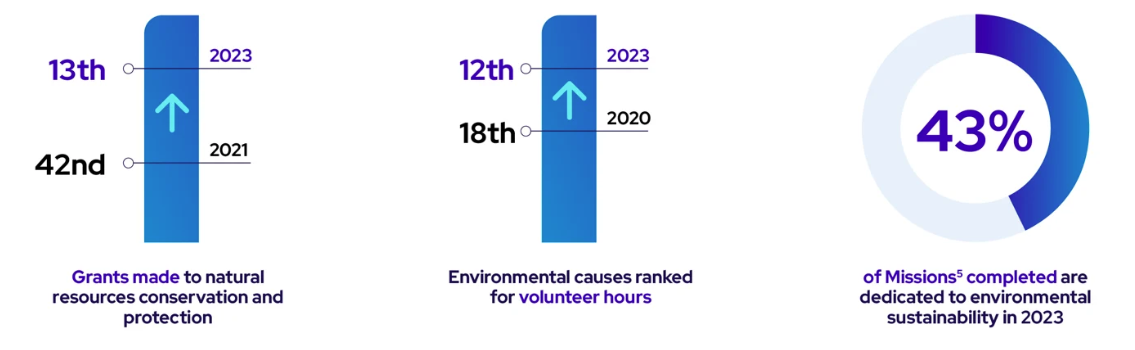
Following a year where ESG backlash dominated discourse and news headlines, it's not surprising companies are making some shifts that will change the way they show up in the world.
To be clear, ESG is far from “dying”: 62% of leaders say there is less use of the term ESG, but the same work is continuing.
Employee participation surged, driven by soaring volunteerism
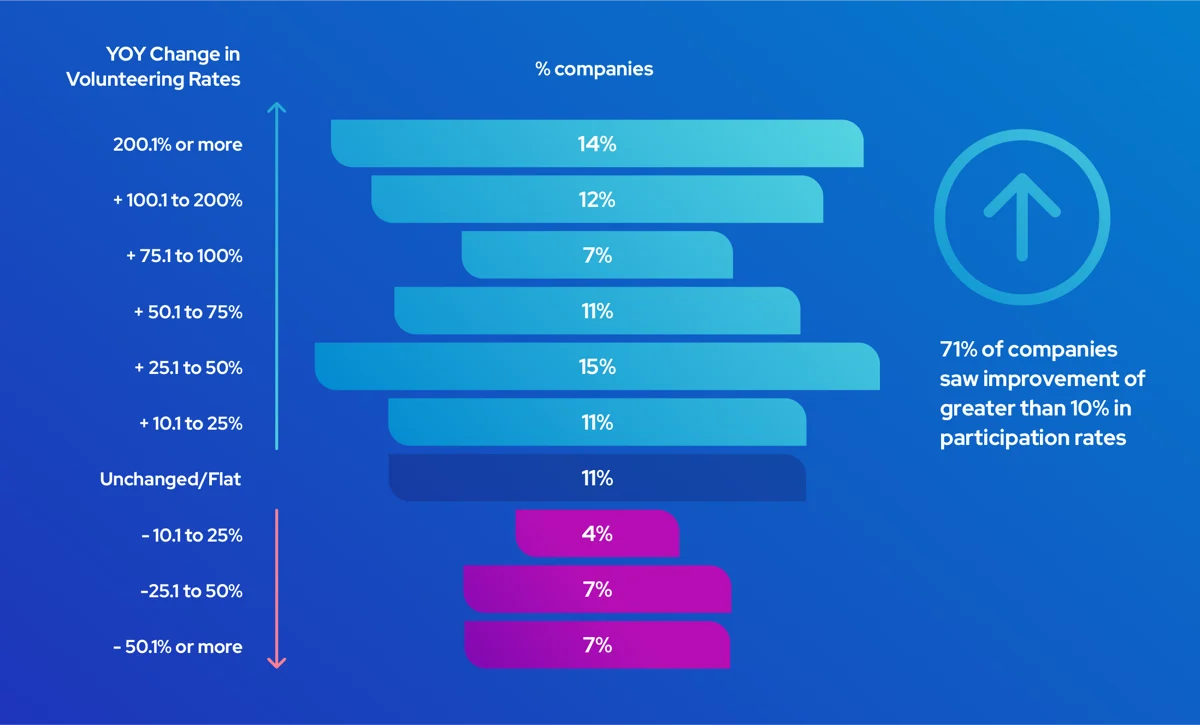
Participation rates6 soared

Volunteer participation rates8 grew across companies
The takeaway
Volunteer momentum is being felt across the board. As companies harness the power of volunteering to unite their people through culture and shared purpose, more people than ever before are getting involved.
A landmark year for volunteering
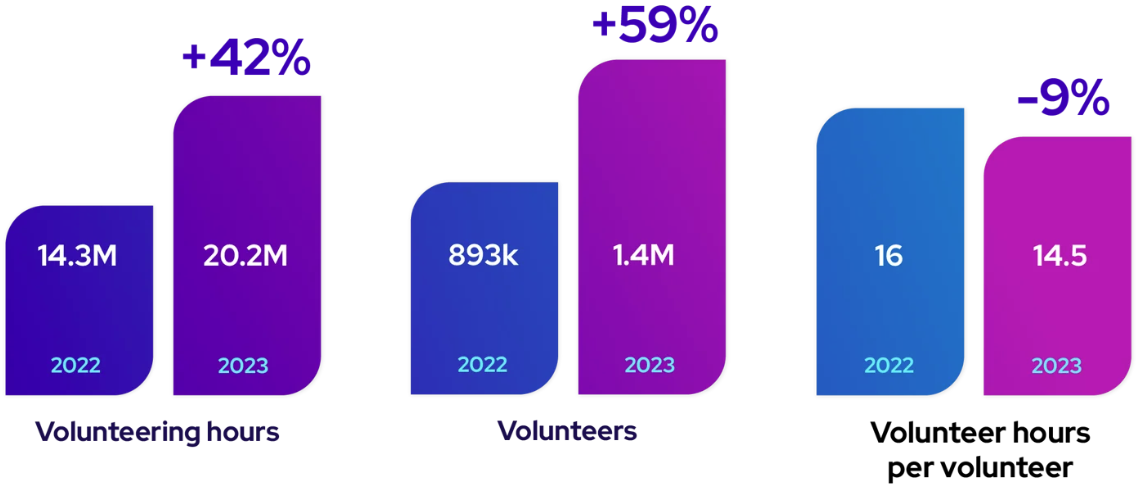
2023 was a landmark year for employee volunteering, as we explored in our recent State of Corporate Volunteering report. As many companies brought their people back to offices, they leaned into volunteering as a way to unify and connect their people through purpose. Amid this growth, we did see one slip – in the number of volunteer hours per volunteer. With so many new volunteers joining the ranks this year, it’s not surprising to see this metric drop.
The takeaway
With hybrid work the new normal, we expect companies and people to continue to seek out volunteer opportunities as a way to build connection and culture. We can also expect companies’ volunteer ambitions to grow.
Top 5 trends in 2024
Trend 1: Companies cautiously use their voice
Leaders are being choosy about where they use their voice and resources, reflecting learned experience about when and how to activate.
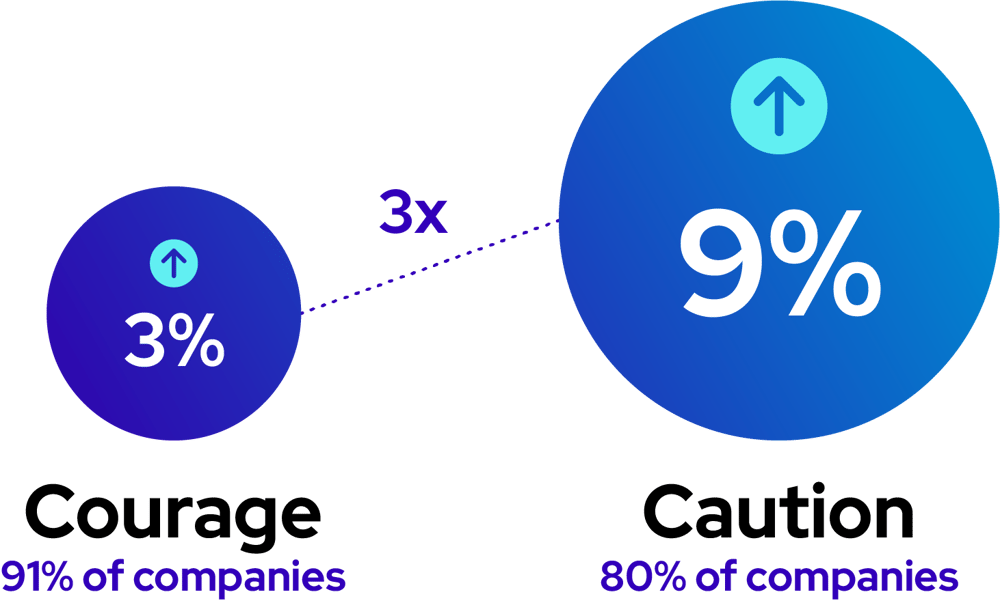
In The State of Corporate Purpose 2023, purpose and polarization went head-to-head. There was an almost even split on whether they should be courageous or cautious. While the tension between the two sides of the dichotomy continues to intensify, caution is now outpacing courage, as companies become more experienced in learning when and how to activate in a way that is resonant and impactful – and aligned with their corporate goals and values.
Caution is outpacing courage
How companies are managing the balance
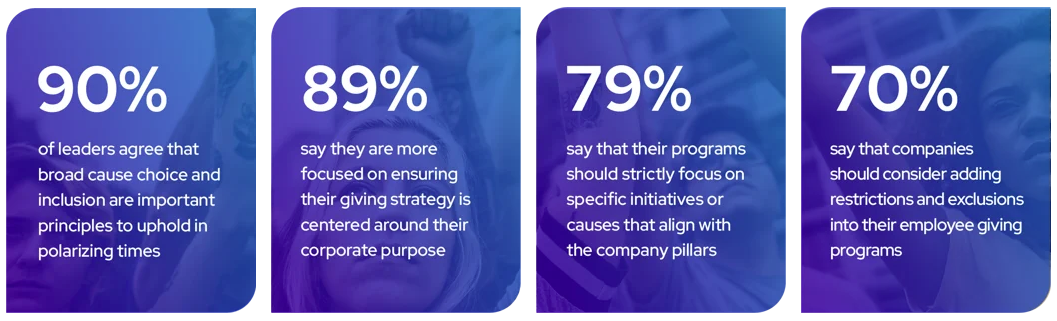

Applying an impact mindset
Our data shows a strong association between companies who restrict the types or number of nonprofits in their employee giving programs and lower participation rates. Limiting choice may not just act as a participation deterrent, but could also be a catalyst for disengagement and, ironically, backlash from employees who see the company as being unresponsive to the passions of its people and to certain social and environmental threats.
The good news is that both courage and caution can be achieved. Companies can start by maintaining broad choice and ensuring causes that have high affinity and participation from employees are included. Then, filters can be judiciously applied based on the company’s specific criteria or requirements, thereby striking a balance between broad choice and alignment to corporate values.
Finally, and most importantly, companies should be clear and transparent about what they will and will not support in their employee program guidelines and communications. This change management exercise is in itself a practice in both courage and caution!

In polarizing times, companies must make decisions that are driven by their values and lead authentically. While every decision may not be embraced by every stakeholder, aligning social stances and corporate actions directly back to a company’s core values engenders trust. When employees and consumers see a company walk-back their support for social issues, they lose their hard-earned trust and loyalty. Adjusting language to avoid 'hot button' terminology is a widely embraced strategy for minimizing backlash. However, those companies that continue to advance their commitments and demonstrably uphold their values will reap financial and reputational benefits that will far outlive this election cycle and other short-term external forces.

Trend 2: ERGs climb the corporate ladder
Employee Resource Groups (ERGs) are transcending their Diversity, Equity and Inclusion (DEI) origins, taking on a broader role in companies.
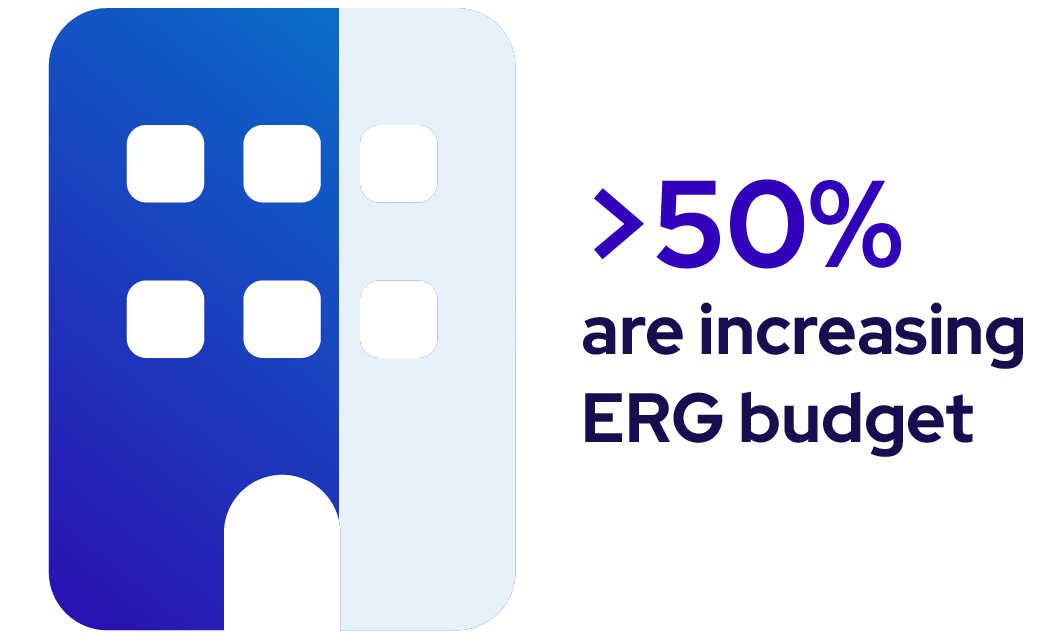
Four out of five companies say that ERGs are increasing in significance and more than half are increasing their ERG budgets. The connection between ERGs and other departments (such as HR and CSR) is strengthening, helping companies become more diverse, inclusive and equitable, while also building better businesses.
86% of impact leaders say their company's leadership sees ERGs as critical to culture. Despite a wave of backlash, companies have continued to invest in DEI, and more specifically in their ERGs as sources of community and belonging.
Particularly in North America, we have observed a notable rise in the importance of ERGs to all levels of employees.
ERGs on the rise

ERGs are integral to social impact
CSR teams, in particular, have found powerful allies in these employee-led groups who care deeply about advancing opportunities and outcomes for the communities they represent. More CSR teams are collaborating with ERGs to enhance awareness, engagement and impact. These partnerships aim to add authenticity to critical cultural moments and crisis responses, and to influence impact strategies, funding and decision-making.
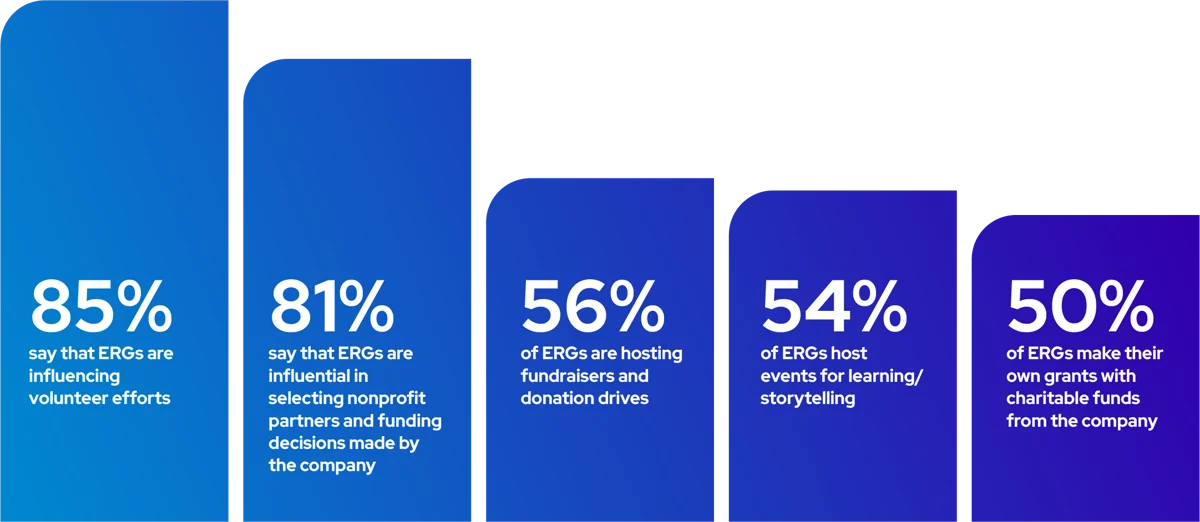
This deepened partnership between ERGs and CSR teams has led to higher engagement in employee giving and volunteering programs, a higher willingness to recommend the company by ERG members and a talent pipeline that’s more diverse.
Applying an impact mindset
With so much tangible value to the business, ERGs can no longer be managed off the side of the desk if they are to deliver on their full potential. If companies wish to leverage the power of these grassroots networks to drive inclusive workplaces and deepen business impact, the opportunity lies in providing support through senior-level championship, budget, purpose-built technology, tools and enablement and most importantly — a seat at the right tables.

As we look towards the future, the sustained investment in ERGs by companies around the globe underscores their crucial role in not only nurturing community and belonging but also in contributing significantly to the company's strategic direction. The statistics are compelling: From unlocking new business avenues to shaping volunteer initiatives and philanthropic efforts, ERGs are central to enhancing the employer value proposition and embedding corporate social responsibility into the corporate ethos.
Across industries, we're witnessing a strengthening collaboration between ERGs and various company departments, such as human resources, marketing & brand and CSR. Such partnerships not only reinforce our dedication to creating a workplace where belonging and equity are paramount but also leverage diverse viewpoints to refine our policies, improve our communication strategies, and cultivate an environment where every employee and consumer feels genuinely valued and understood. Now is the time for organizations to acknowledge the substantial impact of ERGs on advancing DEI objectives and to provide them with the requisite support, including senior leadership endorsement, funding, purpose-built technologies, and most importantly, a prominent voice in decision-making processes.
Trend 3: Volunteer programs level up
With an unprecedented number of active volunteers, companies are reimagining the possibilities.
Hybrid work is now the norm and volunteer programs are a critical tool in culture building and employee engagement. We explored this phenomenon in our recent report, The State of Corporate Volunteering.
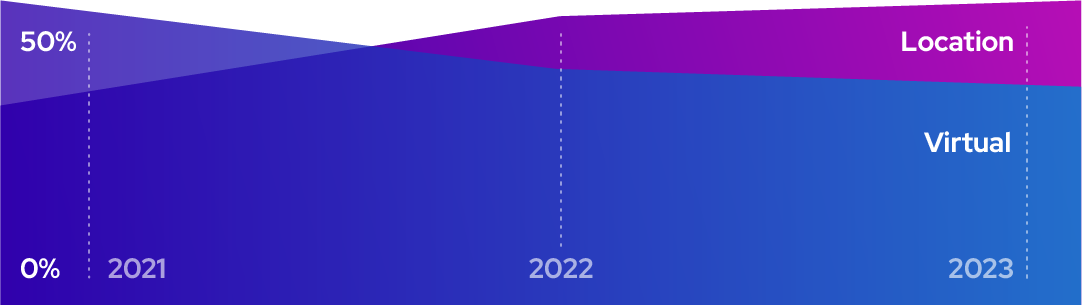
A notable development this year is that location-based volunteer opportunities pulled ahead of virtual ones, and now represent the majority of volunteering opportunities.
In-person volunteering pulls further ahead of virtual
Volunteer Acts of Kindness are here to stay

Even as volunteer ambitions grow, it’s important to note the enduring popularity of Volunteer Acts of Kindness (VAOK)9, which are small acts of goodwill not tied to a specific nonprofit – such as a beach cleanup or attending a session hosted by an ERG. These types of volunteering activities accounted for 36% of total hours in 2023. They’re a critical engagement tool, with nearly one-third of volunteers only engaging in VAOK.
More than half of companies (55%) are now evolving their programs further, focusing not just on creating employee connections as they did the past few years through return to office programs. They are now also focusing on driving social impact more deeply through skills-based volunteering and nonprofit board service programs.
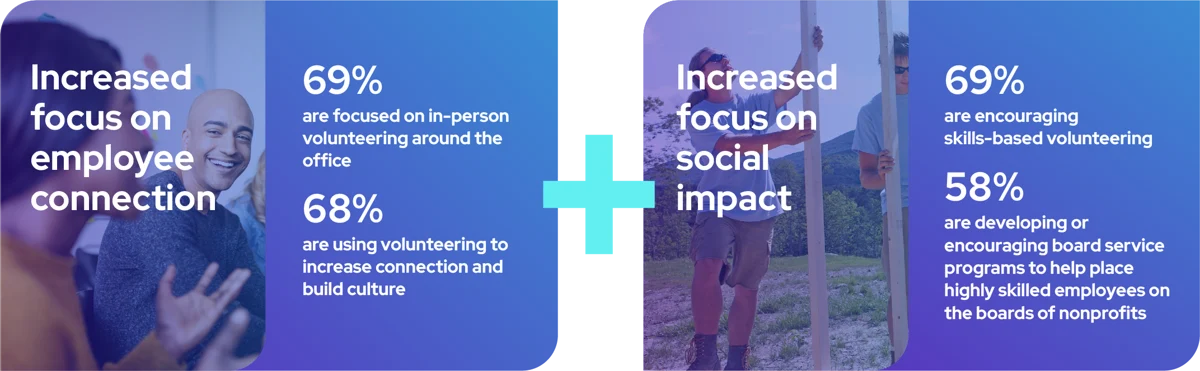

59% of volunteers were new in the past year – a direct result of companies investing in volunteering to build (or re-build) their culture.
Applying an impact mindset
While fast on the rise, global volunteer participation rates are still on average under 10%, representing a big opportunity to continue to bring new volunteers in the door and more deeply engage them over time. Companies have choices about how to manage their volunteer programs this year, especially given potential budget and resource constraints. Do they wish to focus on nurturing existing volunteers to deepen engagement and impact, or do they wish to focus on the attraction and recruitment of net new volunteers? Better yet, companies can tackle this from all angles by developing life cycle strategies that help employees climb the curve from first-time participation to deep and lasting engagement.

In this hybrid world, it’s more important than ever to create a culture of volunteerism where employees feel inspired to volunteer, empowered to support causes they’re passionate about, and acknowledged for their contributions. Culture matters because it’s lasting and it’s authentic. It’s not about checking a box and moving on to the next thing. Building and nurturing a culture of volunteerism allows your programs to be consistent and sustainable.
Trend 4: AI for all
Impact leaders are being actively engaged by their companies to ensure their AI practices are ethical and responsible, ensuring no one is left behind as hype for the transformative technology peaks.
Artificial intelligence (AI) is rapidly changing our world, and our sentiment towards it is changing almost as fast. As AI started to gain traction last year, we saw strong feelings on both sides. There was optimism that it could unleash humans from repetitive and rote work and usher in new innovations. We also heard cynicism and caution around how it might further create a divide between those who have access and those who don’t and pose a risk of widespread job loss. This year, we're seeing cautious optimism.
The promise and peril of AI

According to the impact leaders we surveyed
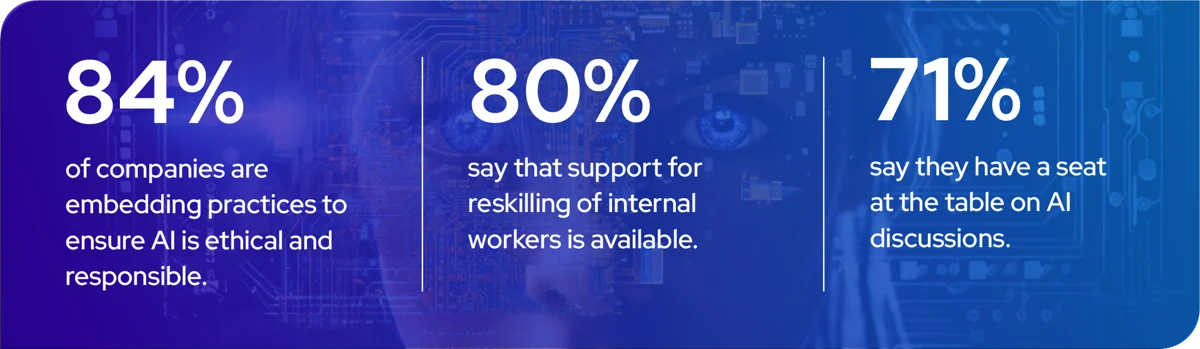
Thanks to early and high engagement with CSR leaders, companies are bringing a human-centered approach to AI, attempting to ensure that their strategies don’t lead to unintended consequences or harm, and ultimately, create access and opportunity for all.

We have already seen remarkable examples of how AI is being applied to help address some of the most pressing challenges facing the world. AI empowers nonprofit organizations to amplify their impact through innovative solutions that uplift communities, protect our planet, and drive positive change. From local nonprofits to global organizations, AI's transformative power also helps streamline operations for greater efficiency and reach. At Microsoft, our approach to AI is deeply rooted in responsibility, guided by principles of fairness, reliability, privacy, inclusiveness, transparency, and accountability. Helping organizations that are closest to people and communities leverage new AI technologies gives us both hope for the future and the power in the present to create change. Our collective work is helping empower a world where we may be able to solve problems once deemed unsolvable.
CSR teams are using AI for efficiency and insight
The top use cases are aimed at driving efficiency and insight, with some interest in using AI for innovation.
Top use cases
-

Finding data points to support plans and strategies
-
Researching and developing recommendations on policies and processes
-
Drafting copy for campaigns or initiatives
-
Suggesting innovative ways to solve social problems
-
Identifying options for innovative reporting and analysis techniques
-
Drafting strategy
-
Suggesting nonprofit partners
Supporting AI skills learning and adoption in the nonprofit sector
A surprisingly high number of companies, 7 in 10, are supporting AI skills learning and adoption in the nonprofit sector. They’re doing this through grants, in-kind donations, skills-based volunteering or even simply hosting learning sessions and summits to educate and equip nonprofits with some know-how.
This trend is driven by the tech and finance industries, who are early adopters and evangelists of AI. The rapid pace of investment in the nonprofit sector bodes well for the intention to bring everyone along on this transformative journey.
Applying an impact mindset
The risk of an AI divide – between those who can access it and those who cannot – is being proactively addressed by companies who are moving quickly to ensure everyone is included.
81%say that their company cares about ensuring underserved communities are not further disadvantaged by the mainstreaming of AI
72%of companies are invested in supporting AI skills learning and adoption in the nonprofit sector in some way
71%say that re-skilling of workers beyond their company is part of their philanthropic strategy

AI will fundamentally change the social sector. It’s speeding up nonprofits’ ability to create more impact. It’s inspiring nonprofits to develop new approaches to serving their beneficiaries. It also threatens to exacerbate social inequalities thereby increasing the need for nonprofit services. CSR leaders are powerful intermediaries in these rapidly evolving times. They understand the needs of the private and social sectors. They are the translators both sectors desperately need. CSR leaders can unlock access to compute, technical capacity, and strategic advisement for nonprofits. In working with AI-powered nonprofits through activating philanthropy, product donations, and employee volunteers, companies will also gain exposure to new product use cases and ethical considerations. The interplay between CSR leaders, companies, and nonprofits can help develop the AI-powered future we deserve.
Trend 5: Outcomes-driven philanthropy has arrived
The tight economic environment of the last year is forcing every business to demonstrate value and return on investment.
Impact leaders need to harness data to rationalize their spend and confidently demonstrate outcomes to higher ups, by showing their work doesn’t just “feel good” but actually “does good” as well.
Impact has to be measured to be believed
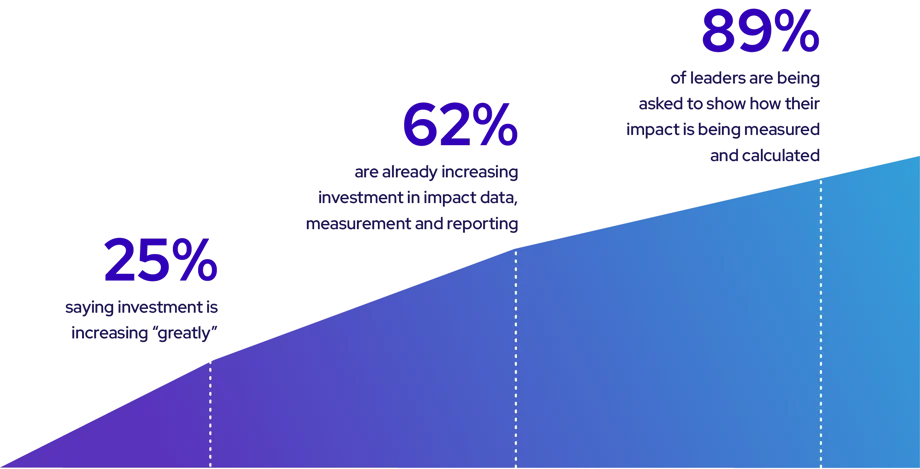
Impact leaders are exuberant about the fact that impact data will help justify increased investment in their programs and allow them to achieve their efficiency and business goals.
- 90% of leaders say that more impact data will increase investments
- 88% need to be able to compare nonprofits on their outcomes to make better investment decisions
- 86% need to be able to compare their impact with other companies
The downside of reporting — the burden on nonprofits
But there’s another side to the story: the work that goes into the reporting. For the second year in a row, we overwhelmingly heard that impact reporting shouldn’t put a burden on nonprofits (92%).
Data from Chief Executives for Corporate Purpose (CECP)’s Giving in Numbers 2023 Edition suggests it's going to be burdensome and inefficient for all stakeholders if we continue to do it the way we’ve always done it.
The current approach is manual, inefficient and lacks standardization.
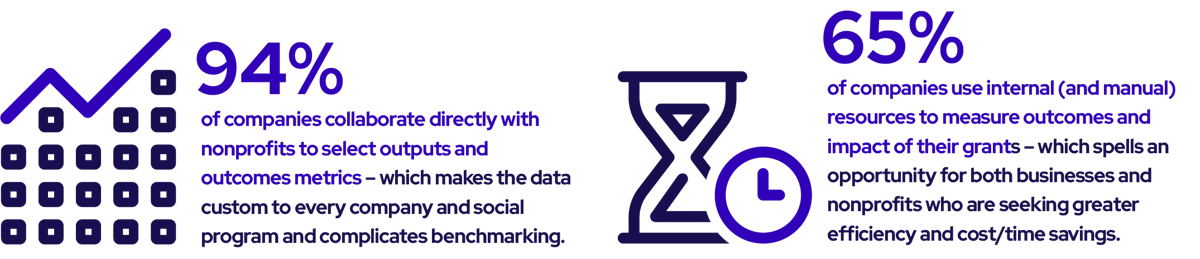
All together, this data reveals a powerful opportunity to bring scale to an area of CSR that has been ripe for disruption for decades. With more companies driving towards efficiency gains and cost savings, now is the time to consider reinventing the traditional approach to Measurement & Evaluation (M&E). But it will take the courage of impact leaders to shed old habits and approaches to historical data to truly realize the value of outcomes-driven philanthropy.
Applying an impact mindset
Companies that have proof that their social investments are driving both business value and social impact will be the ones who sustain budgets and leadership support over the long haul. Increased investments in trustworthy, standardized data, measurement and reporting as well as a focus on outcomes will dominate the space for the foreseeable future.
Gone are the days of listing inputs, outputs, total dollars given and number of hours volunteered; we are now moving to outcomes–driven CSR.

Increasingly, the rationale for corporate philanthropy inside many of America’s leading companies is shifting from ‘doing good’ to ‘generating outcomes.’ There’s a difference. Doing good is about the act of giving to charity; generating outcomes is about the results. This shift – from activities to outcomes – is taking place for three reasons. First, social outcomes now have material financial impact on business. Companies desperately need education outcomes to source talent, affordable housing outcomes to retain their workforce, and health outcomes to drive productivity. Second, employee engagement goes up when employees can see the outcomes of their efforts. And finally, investors are taking greater interest in a company’s social impact. ‘Do no harm’ isn’t satisfying impact investors, ESG funds or pensions and endowments that are seeking returns, plus positive impact. The ability of companies to standardize and aggregate their social outcomes – across employee giving, volunteering and grantmaking – is a game changer for those who want to go beyond inputs and outputs and satisfy today’s stakeholder demands.
Conclusion
Businesses can confidently navigate the rest of the 2020s by embracing an impact mindset.
As the dust settles from a rocky start to the decade, we have a clear sightline into the second half of the 2020s. The question of purpose is settled now – it matters. It’s no longer a separate wing of a company; it’s what makes a company fly. 2024 is shaping up to be a year in which companies will tie their impact strategy back to the business’s core focus and corporate values, with a sharpened focus on generating proof of positive return on investment (ROI) for the company and its communities. By embracing an impact mindset, companies have the opportunity to catalyze change from the inside out. This is how businesses won’t just survive, but thrive.
Methodology

Benevity, a certified B Corporation, is the leading global provider of social impact software, providing the only integrated suite of community investment and employee, customer and nonprofit engagement solutions. Benevity provides a robust, all-in-one SaaS platform designed to simplify and scale CSR and social impact programs. The platform unifies giving, volunteering, grants management and employee mobilization - empowering companies to connect purpose with measurable business results. Benevity has processed more than $18.5 billion in donations and 99 million hours of volunteering time to support 513,000 nonprofits worldwide. The company’s solutions have also facilitated 1.5 million acts of goodness and managed grants worth $18 billion. For more information, visit benevity.com.